
Midland leaders set conditions for future data centers
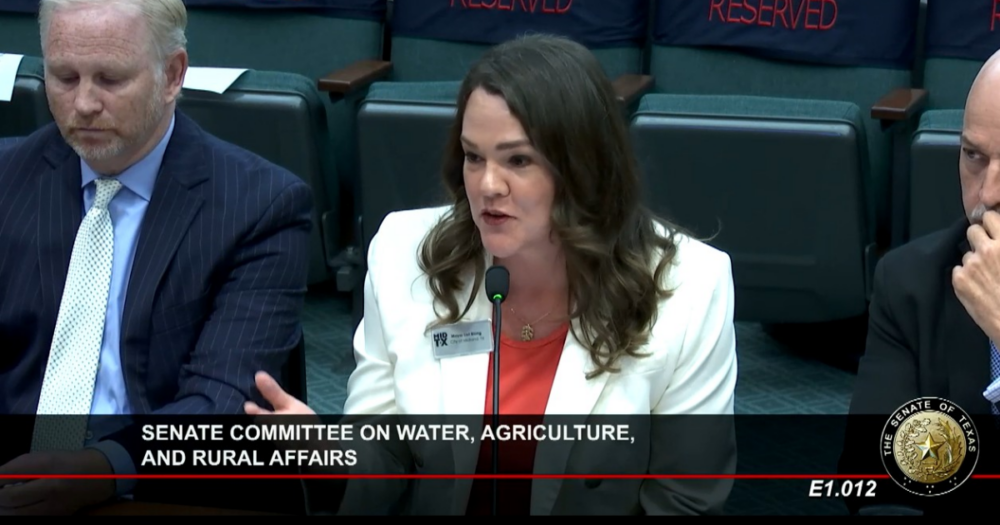
Photo credit: Mayor Lori Blong
What happened: Policy experts say data centers could bring economic opportunity to West Texas, but Midland’s local officials are increasingly signaling that their support depends on whether companies can meet their own power, secure their own water, and avoid burdening local infrastructure.
Recent comments from Midland Mayor Lori Blong and County Judge Terry Johnson suggest local leaders are not rejecting data center development outright, but are drawing clear conditions around what they believe acceptable projects should look like.
Why it matters: Data centers are part of a broader AI-driven infrastructure boom that could expand Texas’s tax base. Texas Policy Research, a free-market policy organization, says Texas has become attractive for AI infrastructure because of its cheap land, business-friendly regulatory environment, and energy market. The group argues that Texas should not respond to data center growth by restricting projects.
Instead, Texas should build enough power and infrastructure to support that demand while ensuring companies, not residents, pay the costs. That debate is becoming more relevant in West Texas as developers increasingly eye the area for future projects.
The big picture: On KWEL radio May 13, Blong said she does not believe data centers belong in the middle of the community, and that Midland should not sell them municipal water.
“I believe the only appropriate way for data centers to be developed in West Texas is for them to solve their own water solutions and their own power solutions, and that it be out away from neighborhoods and families,” Blong said. “We’ve just spent most of this show talking about our water limitations, but we also have energy limitations.”
Blong said most of the developers she has spoken with describe plans to build in the county, generate their own natural-gas-fired power, and use closed-loop water systems supplied by non-Midland municipal sources.
Johnson, speaking on KWEL the day before Blong, said three different data center groups have approached the county. He said the developers he has spoken with also describe using closed-loop cooling systems and on-site natural gas generation, which, in some cases, they say could return excess power to the grid.
“These folks want to be good neighbors, so they’re always trying to improve what they’re doing,” Johnson said. “I feel like they don’t want to come in and just take over a county and take everything.”
Go deeper: The local discussion comes as state officials increasingly debate whether West Texas has sufficient power infrastructure. At a Texas Senate Water, Agriculture & Rural Affairs Committee hearing on May 11, State Sen. Kevin Sparks and Blong discussed West Texas’ limited natural-gas-fired generation and the need for more dispatchable power in the region.
“We’re very frustrated with the lack of gas-fired power generation in West Texas,” Blong said. “Given our economy and the driver of our economy, we are far too dependent on unreliable energy sources, and so I would like to see increased power generation in the Permian.”
Sparks argued that Texas’s energy market does not adequately incentivize investment in baseload generation and raised the possibility that the state should prioritize building natural-gas-fired plants closer to demand centers rather than relying on new long-distance transmission.
A January 2026 Global Energy Monitor report found Texas has 80.6 gigawatts of gas-fired power capacity under development, with roughly 40 gigawatts, essentially half, tied directly to planned data center demand.
What’s next: The state is signaling that electrical demand and water usage, especially around data centers, will be a key item up for consideration in next year’s 90th Texas Legislature. The Public Utility Commission of Texas is now collecting water-use data from data centers and cryptocurrency mining facilities across the state. The PUC must report its findings to state leadership by the end of the year.