
MDC hears case for investing in workforce, quality of life
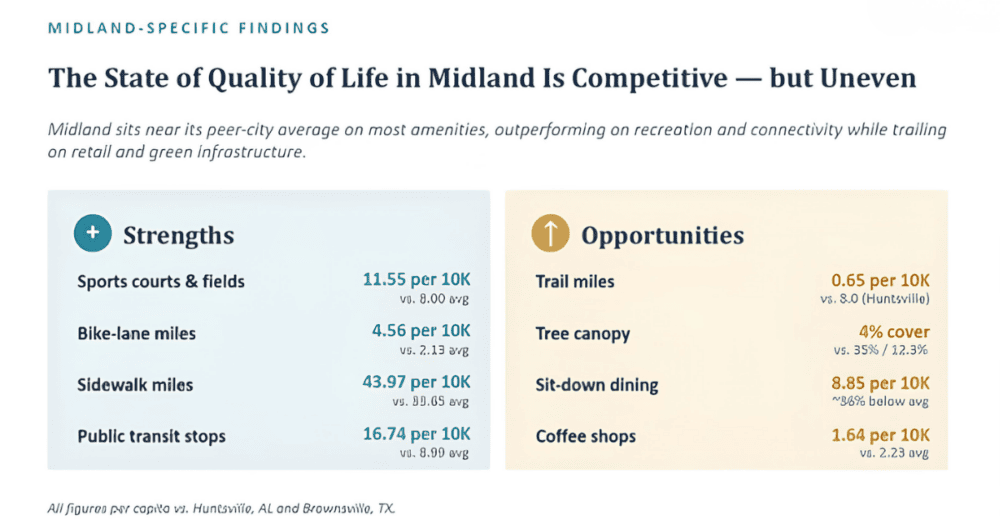
What happened: The Midland Development Corporation (MDC) board met on Monday, Aug. 3, and heard a Texas A&M Bush School presentation recommending Midland treat workforce development and quality-of-life amenities as economic infrastructure. The board also heard a Permian Strategic Partnership (PSP) request to fund $10,000 toward an updated highway economics study they said could help increase TxDOT’s funding to the region.
The board also approved $566,701 for the University of Texas Permian Basin (UTPB) to operate the 2026-27 Midland Entrepreneurial Challenge, while board members pressed administrators for stronger data on the program’s return on investment.
Editor’s note: The MDC is an economic development corporation created by Midland voters in 2002 that receives a quarter-cent of the city’s sales tax.
Key points:
- A&M Bush School presentation: Working professionals from an executive master’s program in the Texas A&M Bush School of Government and Public Service presented the results of a 25-week research project on an economic diversification strategy for Midland. The team recommended building energy-industry-based systems that promote diversification and investing in workforce development, housing, and quality of life.
Researchers concluded Midland’s existing workforce possesses many of the skills needed for aerospace, defense, advanced manufacturing, and logistics jobs. Instead of importing workers, they said Midland should focus on retraining its existing workforce through expanded short-term credentials. The group argued that Midland should view investing in workforce development as economic infrastructure like roads and utilities.
The presentation also emphasized that quality of life has become an increasingly important factor in where businesses expand and where skilled workers choose to live. Compared with peer communities, researchers found Midland performs well in athletic facilities, sidewalks and bike lanes but trails in hiking trails, tree canopy, restaurants and coffee shops.
They recommended updating the city’s parks and trails plans, expanding tree planting, recruiting more sit-down restaurants and entertainment, and continuing public-private partnerships for community amenities. Researchers also identified transportation, childcare, and English-language training as barriers preventing residents from completing workforce training programs.
Board Chairman Brad Bullock noted that the program’s participants picked Midland for their case study without any of them having any significant ties to the community. He also said the presentation reinforced priorities the MDC had already been discussing while providing outside research to support them.
- Entrepreneurial Challenge renewed: The board approved a $566,701 agreement with UTPB for the ninth Midland Entrepreneurial Challenge. The funding includes $500,000 in prize money, up to $150,000 per winning business, and up to $66,701 for UTPB’s marketing and administrative costs.
According to MDC Executive Director Sara Harris, the competition has awarded $3.7 million to 39 Midland businesses, most of which remain in business and contribute to the Midland economy. Businesses must be inside Midland city limits, and winners who sell or move the business out of the city within five years must repay the award.
Two board members questioned what return taxpayers have received on the MDC’s years of investment. The program administrator said winning businesses report employment numbers annually, but that they have never compiled those figures into a formal economic impact report. They said next year’s agreement could include that analysis.
- PSP highway economics study: The PSP asked the MDC to contribute $10,000 toward updating a Texas A&M Transportation Institute study measuring the economic impact of highway investment in the Permian Basin. The PSP said the original study helped TxDOT justify a 10-year funding increase for the region against competing demands from Fort Worth and the Gulf Coast. The board took no action on the item.
- MDC Centennial Tower lease: The board approved a five-year extension of MDC’s Centennial Tower lease, keeping the corporation’s 3,324-square-foot offices through September 2031 at a total cost of roughly $374,000. Harris said the lease rate remains below comparable downtown office space.
- MDC’s June sales tax: Harris reported that sales tax collections continue to outperform expectations. Through July, MDC revenues are about 25% above budget, putting the corporation on pace to collect more than $18 million this fiscal year compared with the $15 million originally budgeted.