
MISD moves to dismiss IDEA lawsuit as federal case grows
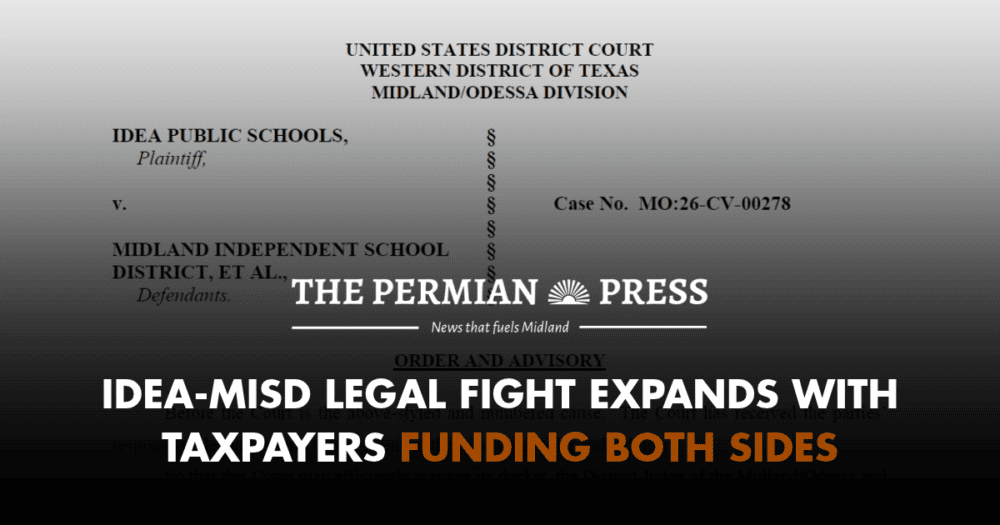
Editor’s note: The Permian Press paid for and reviewed the publicly available documents from federal case 7:26-cv-00278-DC-RCG for this article.
What happened: The legal fight between IDEA Public Schools and Midland ISD over the end of the IDEA Travis partnership has expanded.
IDEA rewrote its original lawsuit after IDEA Travis earned a C in the state’s latest accountability ratings. IDEA argued the new rating strengthens its case that MISD improperly ended their partnership. MISD countered that IDEA is trying to turn what is fundamentally a contract dispute into a federal constitutional case.
MISD and six of the officials IDEA sued are now asking the judge to dismiss IDEA’s federal constitutional claims. If they succeed, MISD is asking the court to dismiss the remaining state-law claims, allowing IDEA to pursue them in state court instead.
Trustee Brandon Hodges filed his own answer and counterclaims, alleging in part that IDEA improperly targeted him personally over decisions made by the full board. He is seeking damages and demanded a jury trial.
Catch up quick: MISD partnered with IDEA in 2019 under a state program known as Senate Bill 1882. IDEA took over operation of Travis Elementary while MISD continued to own the campus. The relationship deteriorated after IDEA Travis received D ratings for three consecutive school years.
The operating agreement allowed MISD to end the partnership over academic performance if Travis was placed in one of the state’s two lowest school-improvement categories for three or more consecutive years. But if MISD terminated the operating agreement on those grounds, it had to provide written notice within 30 days of receiving the state’s ratings. IDEA argues MISD missed that deadline.
Instead, the board unanimously voted to terminate IDEA’s separate lease for the Travis building. IDEA argues MISD used the lease termination to accomplish indirectly what it could no longer do through the operating agreement. MISD maintains IDEA failed to meet the partnership’s academic requirements.
Why it matters: Both public education entities in this case are publicly funded, which means Midland taxpayers are paying for both ends of the expanded fight.
The big picture: IDEA Travis held a D rating for 2023, 2024, and 2025. IDEA argues Texas law does not treat those as three consecutive unacceptable ratings for purposes of the agreement and says the new C means Travis is no longer in consecutive years of school improvement.
IDEA also points out that MISD had approved a C as Travis’s performance target for 2025-26 and approved the campus’s Targeted Improvement Plan less than a month before terminating the lease. IDEA argues MISD approved an improvement plan and then removed IDEA before the year’s new rating was available.
Go deeper: IDEA alleges Board President Josh Guinn told its CEO that MISD intended to terminate the lease before the board had publicly voted.
The complaint also addresses a demand letter Superintendent Stephanie Howard sent IDEA seeking $500,000 for an alleged breach of the operating agreement. IDEA argues MISD breached first by taking away its campus and effectively ending the partnership, which IDEA says would instead trigger a $1 million payment from MISD.
Zoom out: MISD’s central argument is that even if IDEA believes the district broke its contracts, that does not automatically make the dispute a violation of the U.S. Constitution. It also argues IDEA cannot bring a federal claim for an unconstitutional taking of private property because Texas law classifies IDEA as a “local governmental entity.”
What’s next: IDEA has approximately until Oct. 15 to respond. The judge could dismiss some or all of IDEA’s claims or allow them to continue. IDEA must also address Hodges’s counterclaims.
Separately, U.S. District Judge David Counts issued a routine order asking whether all parties consent to having Magistrate Judge Ronald Griffin handle the full case. No hearing dates have been set.