
Pfluger, Reynolds differ on immigration, energy, spending
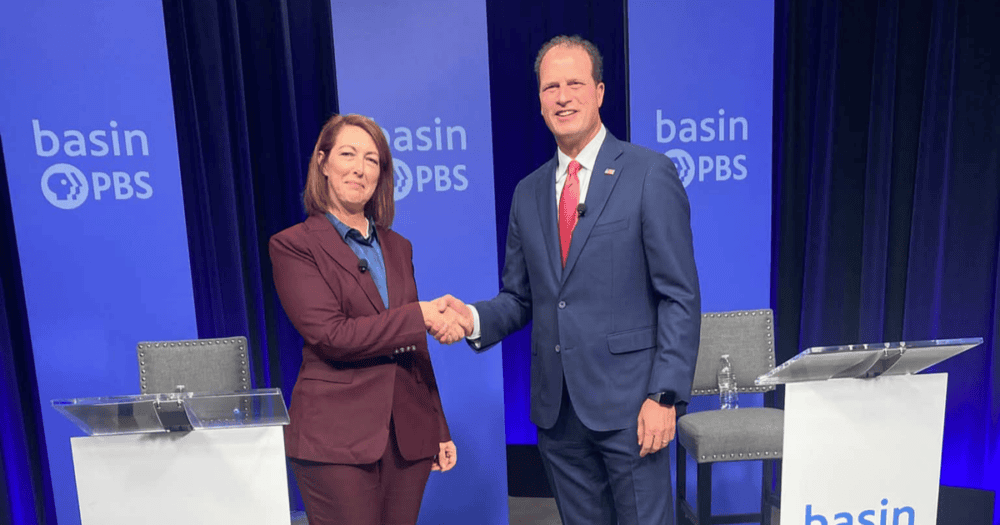
Photo credit: Basin PBS
What happened: Republican U.S. Rep. August Pfluger and Democratic challenger Claire Reynolds faced off in a Basin PBS debate Monday night, laying out competing positions on energy, immigration, federal spending, health care, foreign policy, and other issues ahead of the election for Texas’ 11th Congressional District. Early voting runs Oct. 19-30. Election Day is Nov. 3.
Here are the biggest differences between the candidates:
Energy policy
Question: Should the federal government take action to drive oil prices down to $50 or below?
- Pfluger did not directly answer the question, but said a free market is “so important” and focused on his efforts in Congress to reduce federal regulations on oil and gas production. He criticized the Biden administration’s energy policies and said the country should “always unleash American energy.”
- Reynolds did not directly answer the question, but said she would not vote for something that would cause constituents in the district to lose their jobs. She said West Texas should remain a leader in oil and gas while also expanding other forms of energy, including solar and wind.
National debt
Question: Does the $40 trillion national debt concern you, and what should Congress do about it?
- Pfluger said yes and pointed to $1.5 trillion in spending cuts he said Congress had passed. He called for greater accountability across federal agencies and said the Pentagon and other agencies should undergo annual audits.
- Reynolds did not directly say whether the debt concerns her, but said she agreed government waste should be eliminated but criticized the spending cuts Pfluger cited, saying they came “on the backs of the poorest in our society.” She instead pointed to federal payments to local law enforcement agencies participating in immigration enforcement as spending she believes should be scrutinized.
Immigration
Question: Give your views on immigration and border policies.
- Reynolds said she wants to eliminate ICE. She said the country instead needs a “small, ethical, interior enforcement entity” focused on what she called the “worst of the worst.” She opposed detaining children and mothers and called for a bipartisan solution that enforces immigration laws while acting with compassion.
- Pfluger said he supports ICE and Border Patrol and has voted to fund both. He connected illegal immigration with fentanyl and human trafficking and said the country should “never have an open border policy.”
Social Security/Medicare/Healthcare costs
Question: What should Congress do about the projected depletion of Social Security and Medicare trust funds?
- Reynolds proposed increasing or eliminating the payroll-tax income cap, arguing that doing so could shore up Social Security for future generations.
- Pfluger pointed to legislation he said Congress passed to reduce fraud, abuse, and inefficiencies in Medicare and Social Security. For the longer term, he proposed a joint bipartisan, bicameral congressional committee to address the future of government programs.
Question: What should Congress do about rising health care costs?
- Pfluger pointed to legislation he said would lower insurance premiums by nearly 15%, a bipartisan bill he said would reduce prescription drug costs, and a $50 billion Rural Health Care Transformation Fund he said would send money to hospitals in the district.
- Reynolds focused on rural hospitals and called for restructuring Medicaid reimbursements so hospitals are fully reimbursed. She argued that funding provided through the Rural Health Transformation Program does not make up for other reductions in funding for rural hospitals.
Data centers/ AI
Question: What is your position on construction of data centers in Texas?
- Pfluger said states and localities should decide on data centers rather than the federal government. He also pointed to the Ratepayer Protection Act, which he described as legislation intended to prevent electricity bills from increasing because of data centers or other businesses.
- Reynolds criticized the legislation as too limited, saying it only requires state utilities to consider making data centers pay. She said the federal government should look for ways to protect counties and unincorporated communities from lawsuits by companies seeking to build data centers.
Question: What do you think about government regulation of AI versus industry self-regulation?
- Reynolds called for Congress to develop guardrails with industry leaders, business leaders, academics, hackers, and others. She specifically identified child exploitation, surveillance, corporate abuse, and data center proliferation as concerns, while saying regulations should not stifle innovation.
- Pfluger advocated a “light touch regulatory framework” addressing risks to children and terrorism while warning against overregulation. He said the U.S. needs to continue innovating to compete with China and pointed to work by the Republican Study Committee and House Homeland Security Committee.
Tariffs
Question: What do you believe about tariffs as economic policy?
- Reynolds said tariffs are a “tool and not an ideology” and can be appropriate when targeted at unfair trade practices or national security concerns. She said they become a problem when used indiscriminately or when their costs outweigh their benefits. She also said Congress can take back tariff authority from the president.
- Pfluger said he believes in free trade but that it must be fair trade. He said he does not “normally love tariffs” but defended their use as a tool and praised Trump’s efforts to renegotiate trade relationships, arguing other countries have taken advantage of the United States.
Foreign nations
Question: Seven months into the current conflict with Iran, do you still support the conflict?
- Reynolds said no. She said there was no clear exit strategy or definition of victory and argued the president should go to Congress and present his case for the conflict.
- Pfluger said Iran cannot be allowed to obtain a nuclear weapon and defended the president’s decision. He said he wants the conflict to end “as soon as possible” but argued Iran has posed a longstanding threat to the U.S. and its interests.