
Sex offender ordinance finalized after misinformation corrected
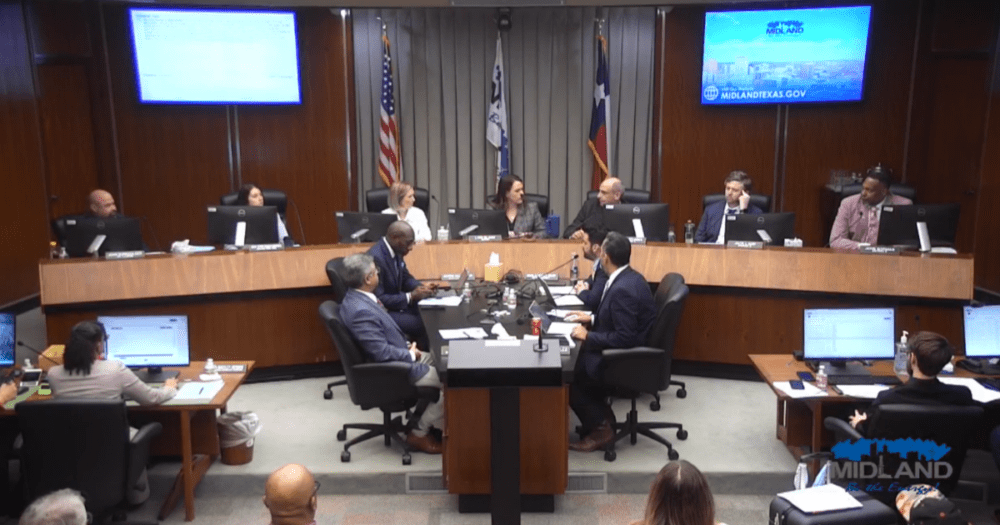
What to watch: The Midland City Council met Tuesday, Feb. 10, and approved an annual paving and drainage contract, finalized a revised sex offender residency and access ordinance, renewed the city’s license plate reader camera contract, and reviewed tourism and economic impact data from Visit Midland.
Key points:
- Sex offender ordinance: Council unanimously approved the second and final reading of an ordinance that prohibits registered sex offenders from living within 1,500 feet of locations where children commonly gather and from entering those locations. The ordinance takes effect on March 1.
City staff said revisions followed concerns from judges and attorneys about enforceability. The updated ordinance requires the police chief to issue written decisions on exemption requests within 15 business days. Appeals must be filed within 30 calendar days and decided within 15 business days. Appeals do not pause enforcement actions unless specifically allowed.
City staff and councilmembers said that the revisions strengthened enforcement while ensuring the ordinance is legally defensible. Ordinances that are not legally defensible are more likely to be challenged or overturned in court. Police Chief Greg Snow previously said the ordinance applies to 253 registered sex offenders, or less than 0.2% of the city’s population.
Federal research has also questioned the effectiveness of residency and proximity buffers. The U.S. Department of Justice’s SMART Office concluded there is “no empirical support” that such buffers reduce reoffending. A peer-reviewed study in Criminal Justice Policy Review similarly found no significant differences in recidivism based on proximity to restricted areas.
- Paving and drainage: Council unanimously approved a resolution awarding $1.5 million to a company for citywide paving and drainage. Councilman John Burkholder asked staff to explore whether smaller local contractors could compete for smaller projects currently bundled into larger contracts.
City staff said local contractors have raised similar concerns and said staff is evaluating bid accessibility. Mayor Lori Blong said the competitive bid process is important, but should be accessible. The resolution did not create a new tax, fee, or rate. It authorized spending from funds already approved in the city budget.
- License plate readers: Council unanimously approved a two-year contract to continue using 73 license plate reader cameras. The contract costs $225,500 per year. For a detailed breakdown of how the system works locally, including data retention limits and access controls, see The Permian Press full review.
-
Public comment: During public comment, a single recurring speaker raised objections across multiple agenda items. She compared the paving contract to the Boston Tea Party and ancient Babylon. Staff and councilmembers made it clear during the meeting that the paving contract involved previously approved funds.
The speaker described license plate readers as government overreach while also urging stronger restrictions under the sex offender ordinance. Her comments reflect opposite expectations of government. One position limits government authority, while the other expands it.
Staff and councilmembers corrected those assertions saying that the ordinance revisions were intended to strengthen legal enforceability, and that the camera system operates under defined access and retention policies.
- Visit Midland: Visit Midland reported attracting 124 total events in fiscal year 2024–25, including 72 new and 52 repeat events. Those events generated 33,930 hotel room nights and an estimated $48.5 million economic impact. About 81% of room nights were for youth sports. For fiscal year 2025–26, Visit Midland has 127 events booked, projects 40,000 to 50,000 room nights, and estimates an economic impact of over $50 million.