
Dianne Anderson on finishing what the county starts
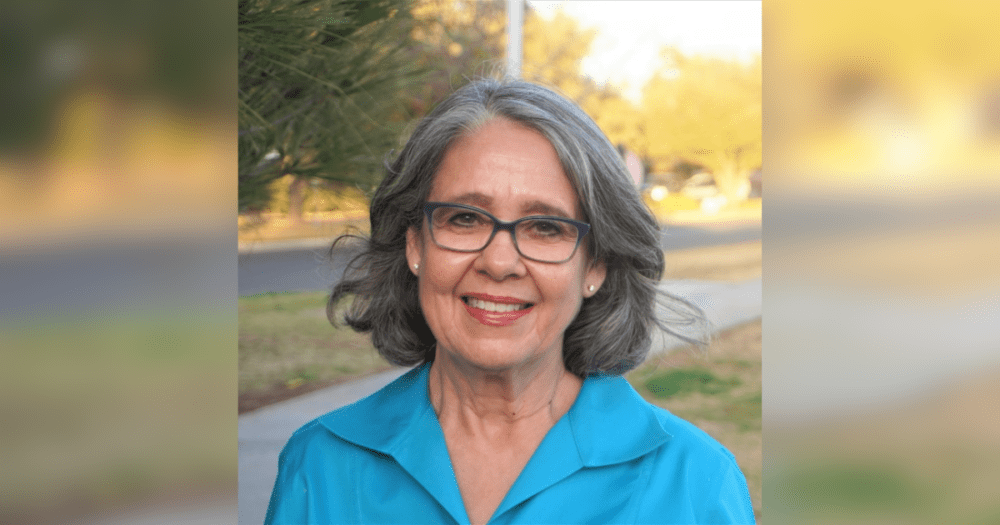
Editor’s note: Dianne Anderson is running for a second term as Midland County Commissioner, Precinct 4, one of five representatives who sit on the Commissioners Court, the county’s governing body, which approves the county budget, sets tax rates, and represents their precinct on local policy matters. Anderson faces two challengers, Don Woodward and Lance Friday.
Candidate interviews are published in the order they are conducted. We conduct candidate interviews using a standard set of questions, with follow-up questions adapted to each candidate’s responses. Voters must register by Monday, Feb. 2. Early voting begins Tuesday, Feb. 17. Primary Election Day is Tuesday, March 3.
Dianne Anderson said Midland County is managing growth, infrastructure needs, and unfinished projects simultaneously, creating difficult decisions about what can realistically be addressed first.
“There are so many challenges right now, and it’s very interesting that there is so much going on right now,” Anderson said. “We need to try to keep up with it.”
“I think the county is still keeping up with what had not been taken care of for many years,” she said.
Finish what’s started before adding more
Anderson repeatedly returned to the need to complete existing projects and keep pace with growth before taking on new obligations. She said growth has created infrastructure pressure that affects the entire county.
“In my Precinct, Precinct 4, there’s a lot of growth there,” Anderson said. “So there’s going to be some roads that are going to have to be added.”
That growth, she said, is not isolated to one area. As development continues, Anderson said the county is working to keep pace with demands that have accumulated over time.
“It would be great if we had the funds to be visionary about the infrastructure, but right now we’re just trying to keep up with the development,” she said. “There’s just so much growth.”
Entity collaboration and shared responsibility
Anderson also emphasized coordination between the county and other entities as a practical necessity rather than a policy preference. She said those partnerships span multiple agencies and service providers.
“Since I’ve been on the court, it has been just a great joy and surprise how well other entities are willing to collaborate,” Anderson said. “They just needed someone to break the ice.”
She described collaboration as a way to combine resources rather than duplicate services. She said it doesn’t serve the community to piecemeal out who does what and who spends what.
“Anytime we combine our resources and we combine our visions and we combine our solutions,” she said. “The community is going to be so much better off.”
Greenwood water and long-term constraints
Water access remains a central challenge in Greenwood and southern Midland County, and Anderson said solutions will require long-term planning and significant investment. Currently, residents depend on private providers and wells, or the possibility of a Midland County Utility District (MCUD) bond.
“There is not a best option for Greenwood,” Anderson said. “The county needs to stay focused on what we need to provide for the jail, because we built it out there.”
Anderson said that she believed if an MCUD bond were to pass, that some sort of immediate solution to residents was more likely to move quickly. She said that MCUD’s infrastructure long-term plan is dependent on a bond, but that it will be up to Greenwood and south Midland residents to determine what they want.
Anderson also noted the county’s investment to advance MCUD facilities as well as water rights the county has acquired to aid in the water situation. Though, she said there are regulatory barriers to how those rights can currently be used.
“We’ve invested $27 million to help MCUD drill those wells and start the treatment plant,” Anderson said.
When asked about the county-owned golf course, Anderson tied its future directly to water availability and potential partnerships with the city to provide water to the site. Though she noted, that she is not interested in the county getting into the golf course management business.
Revenue loss and sales tax choices
Anderson pointed to state-level changes regarding how future appraisal restrictions will significantly affect future county budgets and budget decisions. She noted that House Bill 9 will cause a removal of roughly $450 million in taxable values from the county’s tax rolls.
“That’s a frightening thought,” she said. “It’s going to be a tough budgeting year this year.”
When asked about the hypothetical possibility of the county attempting to increase the sales tax again following a failed 2021 county-wide vote to do so in order to offset a loss of property tax assessment, Anderson discussed the role it could possible play in the future.
“It is something that would be really beneficial,” she said. “but make no mistake about it, it is a tax even if it is largely paid for by nonresidents of the county.”
Law enforcement and differences in services
When asked what level of public safety justifies what level of cost, how the government knows when additional spending produces diminishing returns, and how the sheriff’s budget compares to the city police’s budget, Anderson said county law enforcement faces responsibilities that differ from city police.
“There is just such a big difference in law enforcement for county than there is for city,” she said. “It just doesn’t compare.”
She pointed to specialized units like the anti gang unit and operating the jail, and specialized equipment as examples for the cost differential.
“We have a task force that deals with oil theft,” Anderson said. “The city of Midland doesn’t have that issue.”
Priorities guiding decisions
Anderson aligned her candidacy with the Republican platform and the priorities she said reflect Midland County values.
“The Republican platform strongly aligns with Midland County’s traditional conservative values,” Anderson said, citing fiscal responsibility, limited government, and energy independence.