
MCUD sets water rates, estimates $131 monthly cost with bond
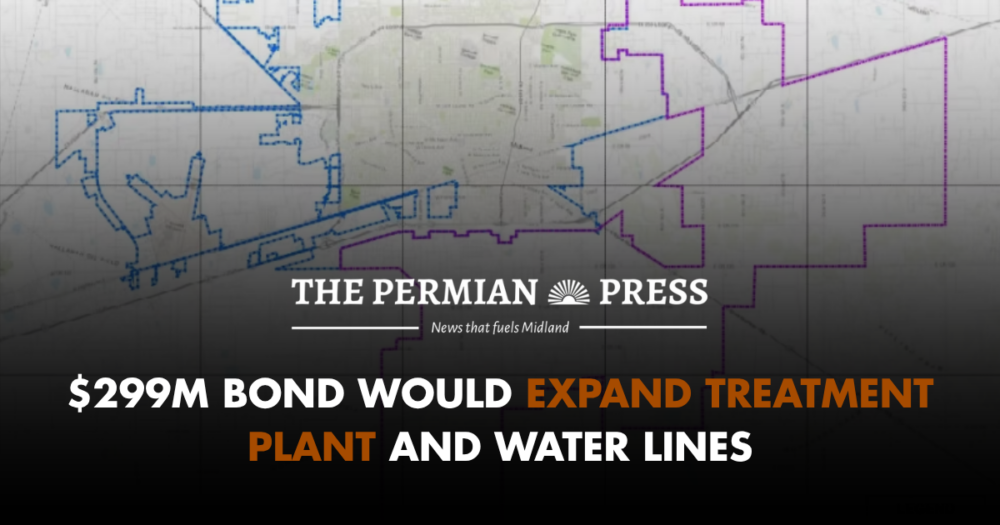
What happened: The Midland County Utility District (MCUD) adopted its first residential water rates during its July board meeting. MCUD General Manager Norman Ashton told KWEL’s The Morning Show with Craig Anderson and Lisa Kay that a combined cost of a proposed bond tax and monthly water bill will total about $131 per month for the average homeowner if voters approve the $299 million bond election this November.
“We know you’re taxed out, but we also know that we can do this and save you money in the end,” Ashton said. “Even for those residential customers who have good wells right now, those are not going to be long-term solutions in 20 years.”
Editor’s note: MCUD is not part of the Midland County government. It is a voter-created, taxpayer-supported public utility district.
By the numbers: The MCUD board approved a $34.89 monthly base charge, which includes the first 2,000 gallons of water. After that, it is $9.87 per 1,000 gallons for the next 8,000 gallons of monthly use, with additional usage billed according to the district’s adopted rate schedule. New residential customers will also have a one-time $2,000 connection fee.
Ashton said district officials designed the rates to recover the cost of operating the system while mirroring the City of Midland’s outside-city water rates so MCUD customers would pay rates similar to other residents receiving public water outside city limits.
The big picture: Ashton told KWEL that the proposed bond would finance the district’s first major phase to expand the district’s existing water treatment plant from its current 500,000-gallon-per-day capacity to between 1 and 2 million gallons per day, and extend water distribution lines to provide water service to residents affected by the chromium plume in the district.
Ashton estimated that fully building public water infrastructure throughout the district’s 85-square-mile service area could ultimately cost approximately $1.2 billion. However, after a change of leadership since the May 2025 $645.8 million bond proposal that 76% of MCUD voters rejected, officials now plan to finance future expansion using multiple funding sources rather than relying primarily on bond funds.
Ashton said the initial bond authorization would allow MCUD to begin construction while becoming eligible for additional financing programs, including low-interest loans through the Texas Water Development Board, federal financing, and future grant opportunities.
Go deeper: With MCUD’s treatment plant fully operational, Ashton said they will begin supplying water to Greenwood ISD’s new campuses this fall. Then the district can begin serving some homes along that distribution line on County Road 110. Also, in the coming weeks, Ashton said MCUD will open a public water fill station where residents can obtain up to 4,000 gallons of water every three days.
Ashton cautioned that expanding public water service throughout the district could take a decade or more because the district currently only has the one distribution line.
He also said the district is nearing an agreement to import water from outside Midland County. He said the district views its current aquifer as an important short-term source but not a permanent solution for Greenwood’s long-term water needs. He added that the landowner agreed to stop fracking on that property once MCUD started taking water on Apr. 29, and that since then the district has seen a two-foot increase in that aquifer level.
What’s next: District voters will decide Nov. 3 whether to authorize MCUD to issue up to $299 million in bonds.