
Texas Senate urges PUC to reject 765-kV transmission plan
What happened: On Wednesday, July 29, the Texas Senate’s Business and Commerce Committee held a hearing to listen to panels of oil and gas industry representatives, utility officials, policy experts, landowners, and the general public on the need and impact of the Public Utility Commission of Texas’ (PUC) proposed $33 billion 765kV transmission plan.
The proposal would create the first statewide network of 765-kV transmission lines, higher-voltage than anything currently on the Texas grid, designed to move large amounts of electricity long distances across Texas.
On Friday, Committee chairman Sen. Charles Schwertner called on the PUC to deny the applications for the 765kV lines, and Lieutenant Governor Dan Patrick backed him, saying the hearing “made it abundantly clear the current process being utilized by the PUC for proposing and approving transmission lines is broken and must be reformed.”
Why it matters: Midland’s state senator, Kevin Sparks, sits on the Senate committee and has been publicly concerned with the PUC’s process for selecting the plans for the statewide 765kV electrical lines. The Legislature passed House Bill 5066 in 2023 directing the PUC to implement a reliability plan for the Permian Basin.
While Sparks supported that bill, he has objected as the Electric Reliability Council of Texas (ERCOT) and the PUC expanded that authority to build the first 765-kV transmission lines across most of the state. According to Texas Scorecard, the PUC chairman acknowledged during the hearing that HB 5066 didn’t explicitly mandate the transmission line build-out.
In July, Sparks and Rep. Brad Buckley formally asked the PUC to delay final decisions on all 765-kV segments until after the next legislative session. They also asked ERCOT to re-run its analysis against the roughly 71 gigawatts of natural gas generation now in the state’s development pipeline, more than three times what the 2024 plan assumed.
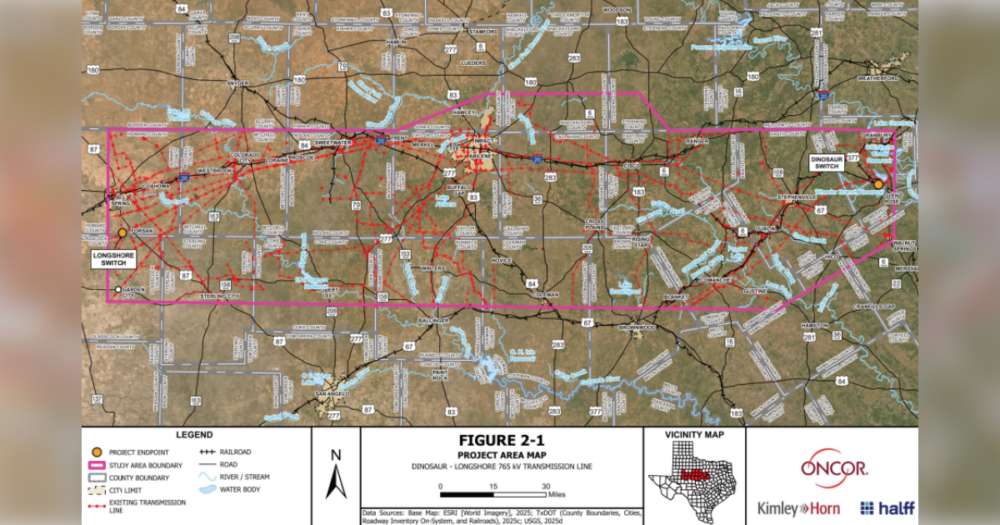
The line nearest Midland, Oncor’s Dinosaur–Longshore project, which would run from a switch near Forsan in Howard County to a new switch north of Glen Rose, has drawn more than 5,700 filings in its PUC docket.
The big picture: The hearing ultimately centered on the Texas grid issues caused by the intermittency of the large amounts of wind and solar generation, along with uncertainty surrounding future electricity demand from data centers. Both issues are especially significant in the Permian Basin.
The region has about 12.4 gigawatts of wind and solar generation capacity but only 2.7 gigawatts of natural gas generation, causing it to swing between exporting electricity and importing it, sometimes within the same day.
The Texas Public Policy Foundation (TPPF) testified that the proposed transmission lines are the most expensive way to solve the problem. A TPPF study found that building 4,000 to 5,000 megawatts of new natural gas generation near West Texas demand would deliver comparable benefits for consumers at a fraction of the cost while adding generation the grid needs regardless.
The catch, TPPF and others noted, is that Texas’ current wholesale electricity market provides little financial incentive for companies to build that type of natural gas generation.
What’s next: The PUC delayed decisions on some of the proposed transmission lines while the lawmakers continue reviewing the project. Texas House Speaker Dustin Burrows scheduled an interim hearing of the House State Affairs Committee on Aug. 19 to specifically examine the 765-kV transmission proposal.