
County reverses Greenwood plat denial after legal review

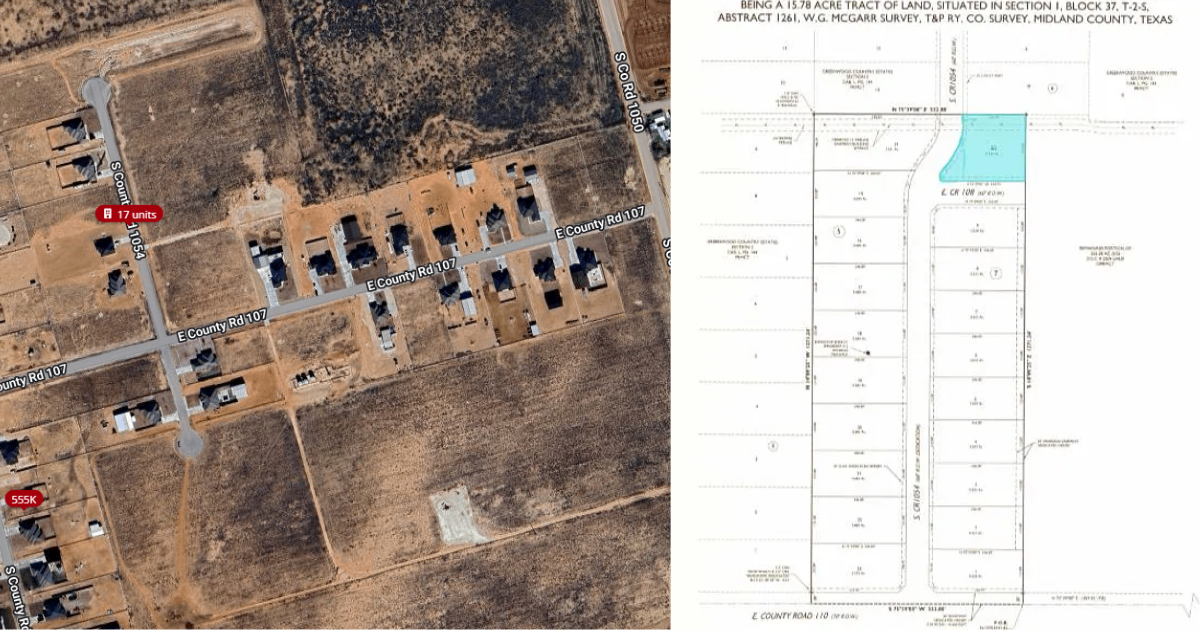
What happened: During a special meeting today, the Midland County Commissioners Court reversed its decision from the week prior, approving a replat in the Greenwood area that had previously been denied due to concerns over water service . The developer clarified that the item was a replat of an existing subdivision, adjusting from three lots to five, not a new subdivision plat.
Commissioners said they spent the last week reviewing state law and concluded the plat met legal requirements and should have been approved. The court voted 4-0 to approve the plat. Precinct 2 Commissioner Jeff Somers was absent.
Why it matters: The reversal highlights ongoing confusion in the community about who provides water in Greenwood, who regulates private water companies, and what authority the county has in approving new development. Until now, the county has provided limited public explanation of the legal framework guiding plat approvals in the county.
Catch up quick: Greenwood is an unincorporated community east of Midland. Residents not on private water wells are primarily served by Park Water Company, a private utility that has faced boil-water notices, low pressure, and water shutoffs. These residents live within the Midland County Utility District (MCUD), a separate governing entity established by voters in 2013. The utility district currently lacks the infrastructure needed to provide water service. In May, MCUD’s proposed $645 million bond to build that infrastructure failed.
As complaints have increased, County Judge Terry Johnson has stated that the county is working within its legal boundaries. He has encouraged residents to contact state regulators, specifically the Texas Commission on Environmental Quality (TCEQ) and the Public Utility Commission, which oversee private utilities like Park Water.
Go deeper: On July 15, the court denied a plat for Greenwood Country Estates Section 7, a six-lot development near County Road 1050. Although the developer submitted a valid will-serve letter from Park Water, which legally satisfied the state’s water requirement, commissioners still voted to deny it, citing concerns about service reliability.
Under Texas law, counties must approve plats within 30 days if they meet statutory requirements or they are automatically approved. Those requirements include a will-serve letter from a utility provider, regardless of whether that provider has the actual capacity to deliver consistent service. Counties are not permitted to impose additional conditions beyond those required by law.
Texas law also states that when a commissioners court denies a plat, it must provide the applicant with a written explanation that clearly outlines each specific reason for denial, includes a citation to the law, and ensures the reasoning is directly related to statutory requirements. The court may not deny a plat arbitrarily or on grounds not outlined in law.
On July 22, the court reconvened and reversed its decision, approving the plat unanimously. The move likely protected the county from legal exposure, as the denial had no clear statutory basis.
What they’re saying: The county issued a public statement clarifying its limited authority. The release emphasized that counties do not provide water service, do not oversee private utilities, and cannot deny plats for reasons outside of those allowed by law. It reiterated that Park Water is currently operating within TCEQ regulations and has recently completed two new wells that have helped reduce service disruptions.
“We understand that water is a vital issue, and we share the concerns of our residents,” said Johnson. “Midland County is not sitting idle. We have worked consistently and legally within our authority to support solutions.”
Villela added that while cities in Texas have broad regulatory powers over development, counties do not.
“This reflects a state policy decision: if a community desires more regulatory control over land development, residents are expected to either move into a municipality or pursue incorporation,” he said.