
How MISD candidates differ on academics, spending, priorities
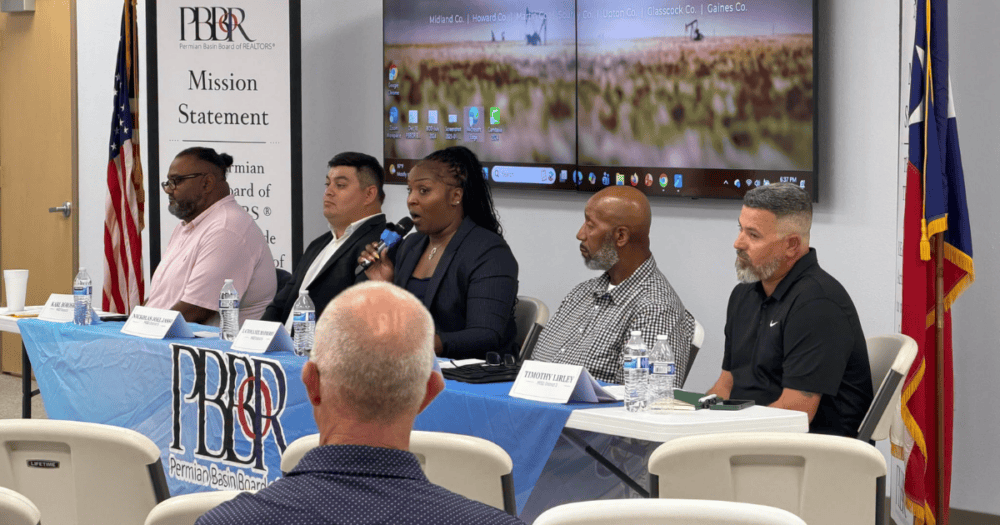
Photo credit: Permian Basin Board of Realtors
What happened: Five candidates in two contested Midland ISD school board races participated in a forum hosted by the Permian Basin Board of Realtors. Not all candidates were asked the same questions, so the comparisons below reflect candidates’ answers across the forum.
The candidates all mentioned keeping more local tax dollars in Midland and prioritizing students and teachers. Their differences emerged over district spending, how MISD should improve student performance, and what each candidate believes deserves greater attention.
Voters in District 3 will choose between incumbent Tommy Bishop and Tim Lirley. District 5 voters will choose between La’Toya Mayberry, Karl Boroski, and Nickolas Jasso. Sara Burleson was the only candidate to file for District 6, and MISD has canceled that election and declared her elected. Early voting begins Oct. 19 and runs through Oct. 30. Election Day is Nov. 3.
The big picture: All five participating candidates supported MISD’s lawsuit challenging the state’s school-funding system known as Robin Hood. Each argued in some form that more of the property-tax money generated in Midland should remain available for local students and schools.
The candidates also consistently returned to improving student outcomes and supporting teachers, although their ideas for accomplishing those goals differed. Their priorities ranged from early education, reading and math to attendance, teacher retention, transparency and maintaining consistent district leadership.
Go deeper: The differences became clearer when candidates discussed where MISD should focus its attention and money. In District 3, Bishop emphasized continuing recent progress, retaining teachers and maintaining stability under Superintendent Stephanie Howard. Lirley emphasized measuring spending against student results, protecting classroom spending and teachers, and finding savings elsewhere.
District 5 candidate Mayberry emphasized early education and addressing learning gaps sooner. Boroski repeatedly focused on attendance, student nutrition, and community mentors. Jasso emphasized reading and math, measurable student results, and detailed oversight of district spending.
Zoom out: Because candidates were asked different questions, the forum did not provide a point-by-point comparison of all five. However, we’ve highlighted the broader priorities each candidate emphasized below.
District 3: Bishop and Lirley
Tommy Bishop emphasized continuity, teacher retention, and MISD’s recent academic and financial progress. He argued that stability under Howard has helped the district improve and said he wants students to graduate prepared for college, the military, or the workforce. Bishop also pointed to the board’s efforts to reduce debt, lower the tax rate, and provide additional compensation for teachers, while describing a trustee’s role as governing the district rather than micromanaging administrators.
Tim Lirley emphasized what he described throughout the forum as “teachers, clarity, and students.” He called for measuring success through reading, math, and readiness after graduation, retaining strong teachers, and making district budgets and performance information easier for parents to understand. On spending, he said classroom instruction, special education, safety, and teachers should be protected, while central-office spending, contracts, and unused space receive greater scrutiny.
District 5: Mayberry, Boroski and Jasso
La’Toya Mayberry emphasized early education, parent involvement, and teacher retention. Drawing on her 17 years in early childhood education, she argued that learning gaps should be addressed earlier and identified struggling middle-school students as evidence of problems that may begin much younger. On district finances, she said MISD should exhaust available resources and look to community partnerships, while also saying she believes the current board has handled the district’s recent budget challenges well.
Karl Boroski emphasized attendance, nutrition, and community involvement as building blocks for academic improvement. The nonprofit executive said his work regularly takes him into MISD schools and argued that students first need to be in class, fed, and connected with mentors before the district can expect stronger academic results. He also linked attendance to district funding and said he would make school-board service a major personal commitment, including spending time on campuses to understand their needs better.
Nickolas Jasso emphasized academic basics, measurable results, and financial accountability. He called for stronger reading and math performance, early help for students who fall behind, and clear options after high school, including college, technical training, industry credentials, and military service. On the budget, he said he would scrutinize administrative costs, contracts, and unused software and programs that cannot demonstrate results, while protecting classroom instruction, effective teachers, special education, and safety.