
Council to consider Opportunity Zone economic incentives
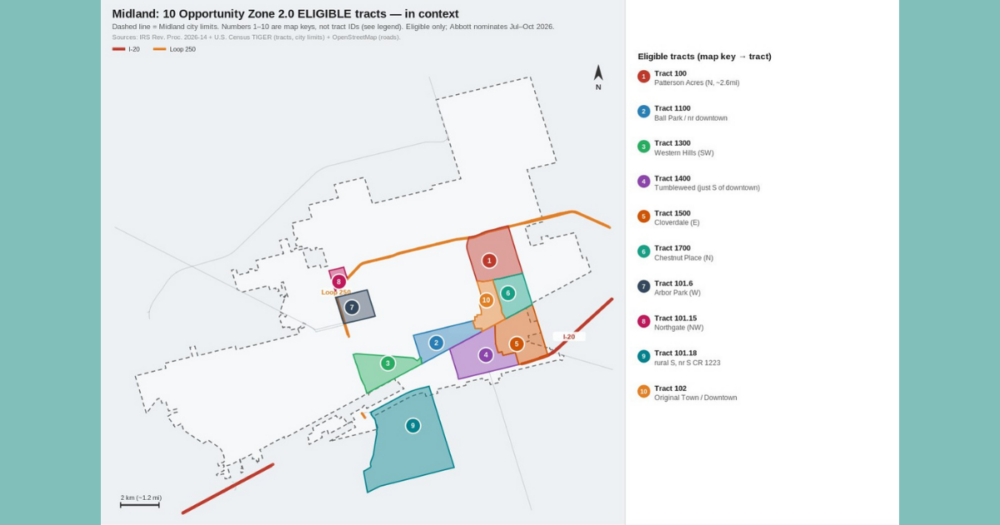
What to watch: The Midland City Council will meet Tuesday, June 23, to consider supporting federal Opportunity Zone nominations for parts of Midland, reconsider a $1.2 million Mockingbird Lane paving contract it tabled two weeks ago, receive a citywide water update, and hold public hearings on oil and gas development near Midland College and next year’s federal community development grants.
The meeting will begin at 2 p.m. instead of the usual 10 a.m. so council members can attend the funeral of former city employee Ed Scott, who was killed in last week’s shooting.
Key points:
- Opportunity Zones 2.0: Council will consider asking Gov. Greg Abbott to nominate eligible Midland census tracts for the federal Opportunity Zone 2.0 program, which offers tax incentives intended to encourage long-term private investment in economically distressed areas.
Ten census tracts in Midland County, shown in the image above, are eligible for consideration. The city can only recommend areas. Abbott decides which Texas tracts to nominate, and the U.S. Treasury makes the final designations. Texas has 2,420 eligible tracts, and Abbott can designate at most 605, or 25%, of them.
A 2017 federal tax law created Opportunity Zones, and last year’s One Big Beautiful Bill Act made them permanent. Midland County did not receive any Opportunity Zone designations during the original 2018 rollout.
Critics, including the conservative Heritage Foundation, argue that the program shifts investment from one neighborhood to another rather than creating new economic activity, and that it gives the government too much influence over where investment occurs. However, much of the criticism targeted the original program, and the 2025 law addressed complaints of a lack of transparency with mandatory reporting requirements.
- Mockingbird Lane paving: Council will again consider a $1.2 million contract to extend Mockingbird Lane between Fairgrounds Road and Purtis Creek Drive. Council tabled this same contract at its last meeting after Councilman John Burkholder said he wanted the adjacent developer to pay a larger share of the project’s cost.
However, the item appears to return to the council unchanged, with the city still proposing to fund the work using the remaining funds from the 2017 Road Bond.
- Midland College drilling: Council will hold a public hearing on plans to drill 20 oil and gas wells near Midland College and the Midland Airpark, as part of a mineral development project that college officials estimate could ultimately generate up to $200 million for the city.
Council will also consider amending a 2022 surface-use agreement to allow additional pipelines and power lines beneath the Midland Airpark, subject to FAA rules. Both items stem from the Midland College Board of Trustees’ March decision to lease approximately 53 acres of college-owned land for oil and gas development to local companies Midland-Petro D.C. Partners and Permian Deep Rock Oil Co.
- CDBG grant funds: Council will hold the second required public hearing before adopting next year’s Community Development Block Grant (CDBG) spending plan. The city expects to allocate about $1.3 million in federal funding, although 12 outside applications and six city project requests totaled almost $2.7 million.
Federal rules require at least 70% of the money to benefit low- and moderate-income residents. The city must submit its final plan by Aug. 15.
- Cybersecurity grants: Council will consider applying for three state cybersecurity grants totaling about $76,000. The city would provide a local match of more than $22,000. The city says the grants would fund system penetration testing, vulnerability scanning, patch management, and cybersecurity training for IT staff.
- Citywide water update: Council will receive a staff presentation titled “Strengthen and Sustain Our Infrastructure” covering the city’s water system. The presentation comes weeks after Mayor Lori Blong told state lawmakers that Midland has enough water to meet current demand but must continue investing in future water supplies because major water projects take years to permit, design, and build.