
Friez visits campuses to hear schools’ needs, challenges
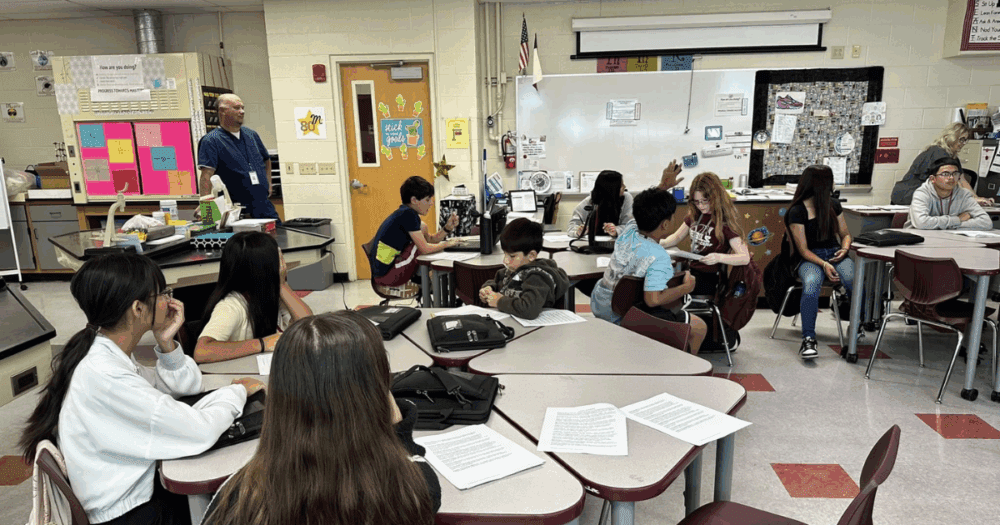
Photo credit: Alamo Junior High Facebook page / MISD Trustee Matt Friez (top-left corner) on a classroom visit. The Permian Press sat down with Friez to discuss his campus walkthroughs. Since becoming a trustee last year, he has visited campuses across the district, often sharing what he sees on his Facebook page. We asked what he’s hearing from campus leaders.
Midland ISD trustees often hear about district-wide trends, but much of the most valuable insight comes from what’s happening inside classrooms. Friez has visited approximately 25 of the district’s 40 campuses this past year, spending up to two hours at each one, and developing relationships with campus leaders. He talks with principals and listens to what teachers and staff are facing.
“I want the community to know that this board is serious about supporting methods that work and that every initiative we champion is grounded in data and research,” he said.
Friez, a board-certified hematopathologist who uses evidence-based practices in his work, is seeking data-driven approaches to strengthen day-to-day teaching, support teachers, and improve student outcomes. Despite the hours he spends away from his business conducting these visits, Friez values the time because he sees how they help inform board-level discussions and the district’s broader improvement efforts.
“When I ran for the Midland ISD Board, I made a simple promise to bring evidence-based practices that add real value to education and improve student outcomes,” Friez said. “Research, not rhetoric, should guide how we lead schools.”
Through these visits, Friez has heard principals request clearer expectations for walkthroughs, more hands-on support, and stronger tools to manage discipline. He said the purpose of these visits is not evaluation, but understanding. “I just try to listen first,” he noted.
Clearer expectations
One practice Friez has observed and championed is principal walkthroughs. The district currently requires principals at A- or B-rated schools to conduct five walkthroughs per week, while those at lower-performing campuses conduct up to 15.
“I’ve met a lot of different principals,” Friez said. “And all of them have their own unique gifts, and I think if they get out in the classroom and use their gifts more, everyone’s going to benefit.”
Friez has seen the practice work well at some campuses. “Some of the principals are highly effective and spend almost the entire time in classrooms,” he noted, describing principals who set up workstations in hallways rather than staying in their offices, allowing them to monitor their buildings more closely.
The district administration has provided research supporting the value of this approach, and Superintendent Stephanie Howard has implemented the practice district-wide as part of her improvement strategy. Friez said principals consistently ask for additional clarity on what makes a strong walkthrough, which he believes the district is working to provide through clearer rubrics and modeling.
“Walkthroughs are about growth, feedback, and continuous improvement,” Friez said. “Not micromanagement. It’s about principals being present, modeling, getting to know the students.”
Editor’s note: The board discussed campus walkthroughs during its Oct. 26 meeting. District staff reported that they track how often principals visit classrooms across the district, and as of October, 79% of campuses met or exceeded their walkthrough targets.
Hands-on support
Through his visits, Friez has also heard principals express a desire for more support from district-level administrators. The district employs principal supervisors, science specialists, reading specialists, and special education specialists whose purpose is to support campus leaders.
“The principals are saying, ‘I wish they would be here more,'” Friez said. “We need them out here more.”
The district has faced staffing challenges as enrollment shifts and teachers move between campuses, leading to larger class sizes. At one elementary school, teacher transfers increased some class sizes to 28 students. Principals have requested additional aide time to support these classrooms and better communication when staffing changes are necessary.
Principals also struggle when the district reassigns assistant principals for district needs. One principal Friez met lost an assistant principal to support another campus. After working hard to improve her school’s rating, she found herself unable to maintain that momentum without key personnel.
Friez said principals have also reported needing more help with the district’s “Teach Like a Champion” professional development program. The program includes “lesson internalization,” a planning process meant to help teachers understand and prepare each lesson in depth. Some teachers have spent 15 to 20 hours per week on this component and have grown frustrated. He noted that one teacher retired mid-year due to the workload.
“If you got somebody that’s spending 20 hours, how can we get them to maybe just do 2 to 3 hours a week but kind of incrementally get better,” Friez said.
In response, the district has provided additional training and support. “They’re finding innovative ways to train the teachers or give them help,” Friez said, noting that central administration staff have been visiting campuses to provide after-school assistance.
The district also employs Multi-Classroom Leaders (MCLs), highly trained teachers who teach part of the day and lead a small team of other teachers to extend the reach of excellent instruction. Friez said principals strongly value MCLs and expressed interest in expanding their model or allowing more collaborative planning time with them.
Stronger tools to manage discipline
Friez said principals consider student discipline a pressing concern, particularly in elementary schools, where challenging student behavior has some teachers and assistant principals considering early retirement.
“We have some discipline issues with elementary kids. Very serious issues that teachers are dealing with. We have had at least one teacher who has quit. Five or six more that are possibly quitting,” Friez said. “It’s mostly due to just way out of control elementary kids that are physically abusive to teachers and principals.”
Friez said parents have become more vocal about these concerns, approaching campus and district administration when problems arise. Principals want more consistency in consequences, which they believe would help staff manage classroom disruptions.
House Bill 6, passed earlier this year, made several updates to school discipline laws, strengthening teachers’ authority to remove disruptive students and limiting when they can return to the classroom. The law expands offenses that require placement in a Disciplinary Alternative Education Program or expulsion. Friez said the district has begun reviewing how the new laws can address discipline problems.
Why this matters for Midland
As principals continue to build relationships with trustees, the district gains valuable insights from those who lead classrooms every day. This trust is essential. During his campaign, Friez noticed a “culture of fear” in the district, where teachers and staff were afraid to speak up about problems. Trustees who are willing to listen are helping shift that dynamic and surface real issues and real solutions.