
Private wells are failing: is it a city problem?

The big picture: Vista Del Pueblo, a neighborhood annexed into the City of Midland more than 40 years ago, is running out of water. Homes rely on private wells, but as new houses are built, some wells are drying up. Residents are now asking the city to step in.
Why it matters: The neighborhood’s situation raises a legal question: Is the city responsible for extending utilities to a development where homeowners bought property without water service and bet on the longevity of water wells in semi-arid Midland?
The bottom line: No, not under current Texas law.
Go deeper: Vista Del Pueblo is a fully platted neighborhood. Under Texas Local Government Code §212.005, cities must approve plats that meet regulations. Once approved, developers gain legal rights to sell lots. The city cannot retroactively deny building permits, even if water access becomes a concern, unless there’s a code violation. In short, the city’s power lies in the platting phase. After that, its options are severely limited.
In some parts of the neighborhood, a shared water system serves up to 14 homes or 24 people, just under the threshold for regulation by the Texas Commission on Environmental Quality (TCEQ). Under Texas Administrative Code Title 30, §290.38(73), exceeding that limit triggers classification as a public water system, subject to tighter oversight.
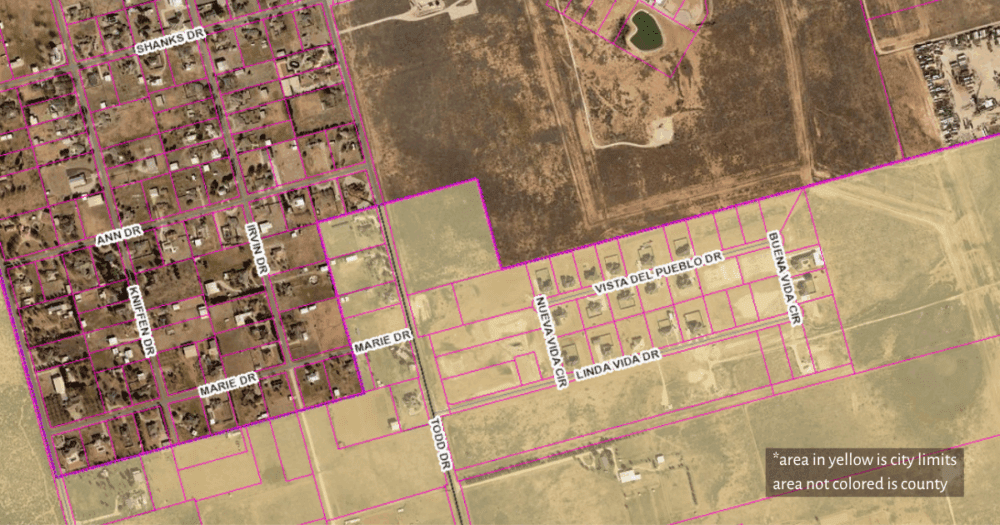
What they’re saying: Residents say the City of Midland believes it legally cannot deny permits because homes comply with the existing code. That interpretation aligns with court precedent. In Alexander Oil Co. v. City of Seguin (1991), the Texas Supreme Court ruled that while cities must plan for services in annexed areas, they also need flexibility to manage infrastructure without court interference.
Another assumption is that annexation guarantees utility access. However, Local Government Code §43.056 only requires cities to plan for infrastructure construction, not immediately provide it. This law, passed in the 1990s, doesn’t apply retroactively and therefore doesn’t apply to the subdivision. Moreover, it allows delays if the city deems service “not feasible or practicable.” One resident reported that the city estimated a $6 million cost to extend water lines, over $300,000 per home.
The other side: What about the developer’s role? Legal action is theoretically possible. If the developer misrepresented water access, failed to disclose system limits, or sold lots knowing the aquifer couldn’t support full buildout, homeowners might have a case. However, groundwater lawsuits are notoriously hard to win in Texas due to the state’s “rule of capture,” which gives broad rights to landowners.
What’s next: Despite the complexity, several paths remain.
- If the system expands beyond the 14-home/24-person limit, it becomes a public water system. TCEQ could then mandate costly upgrades or freeze new connections.
- Texas law (§43.142) allows cities to disannex land under limited conditions. Although politically difficult and rarely used, it remains a legal option.
- Residents could establish a Municipal Utility District to fund and manage water infrastructure. This approach requires long-term commitment and organization.