
MISD has 16 A/B Campuses but 23 schools still lag
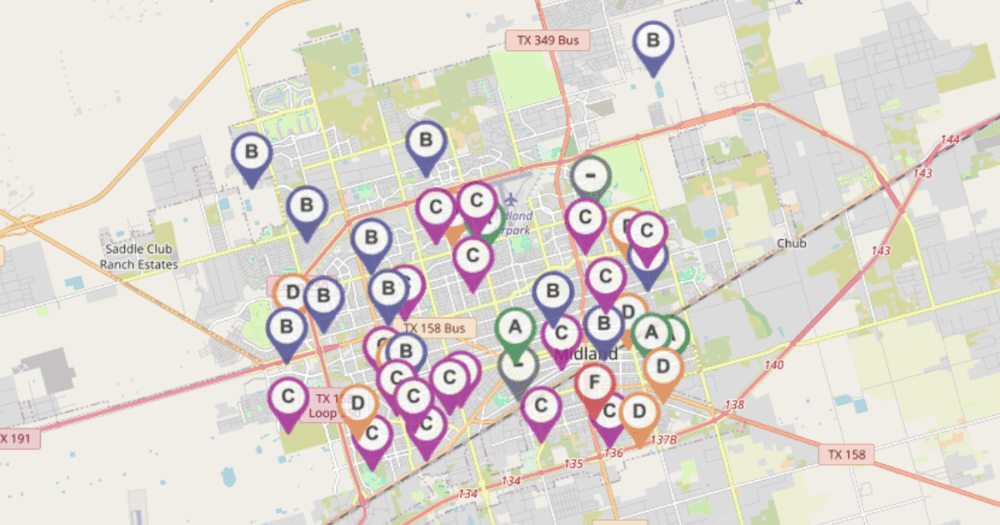
What happened: The Midland ISD Board of Trustees met Aug. 26 to review Texas Education Agency (TEA) accountability ratings and campus improvement plans. While MISD is showing progress, with A and B campuses more than doubling since 2023, 23 schools still hold C, D, or F ratings.
Trustees also discussed the district’s truancy efforts and approved development agreements with the City of Midland to cover costs for roadway and utility improvements at the two new high schools.
Why it matters: The city’s $18.2 million commitment to the school roads highlights costs left out of MISD’s $1.4 billion bond. Whether paid by the school district or the city is irrelevant. Taxpayers will cover millions more than the bond promised.
Key points:
-
TEA ratings: The TEA accountability rating, released earlier this month, showed gains across the district. In 2023, only seven campuses earned an A or B rating. In 2025, that number rose to 16. Campuses rated D or F dropped from 16 to nine.
Board President Brandon Hodges said red marks (C, D, or F-rated schools) signal areas where the district needs to take ownership and push for improvement, rather than indicating outright failure. Superintendent Stephanie Howard added that the district expects every campus to implement best practices and improve, regardless of its rating.
-
Campus improvement plans: Leaders from 23 campuses rated C, D, or F presented strategies to raise performance. Common themes included stronger professional learning communities, teacher coaching, mastery tracking, and reteach cycles after unit tests. Many campuses are also expanding after-school tutoring, Saturday school, and summer learning to close achievement gaps.
Plans set 2026 targets based on 2025 baseline data, with goals written as SMART objectives — specific, measurable, achievable, relevant, and time-bound. (Editor’s note: The Permian Press will publish a more in-depth analysis of these plans separately.)
- Truancy concerns: Trustees heard about persistent absenteeism, especially at South Elementary, where 25–30 students are frequently absent. Principals described home visits and incentives to improve attendance, but said the district needs stronger collaboration with local judges.
While the discussion highlighted South as an example, trustees acknowledged that truancy is a district-wide challenge. Hodges suggested a special meeting to examine attendance efforts across the district and look at practices in other districts.
- School roads: Trustees approved, in a 6-1 vote, development agreements with the City of Midland for infrastructure around the two new high schools. MISD will cover the $27.5 million upfront costs from the 2023 school bond. The city will reimburse the district $18.2 million in three equal payments from 2027 to 2029, meaning the district’s portion constitutes $9.4 million.
During the city council’s meeting on Aug. 26, it was mentioned the city does not have a funding mechanism established for how it will pay for its portion.
-
Enrollment shortfall: Enrollment stands at just over 29,000 students, down 112 from last year and nearly 1,000 below projections. Because the state funds schools based on daily attendance, fewer students means less revenue. The shortfall carries a $6.7 million financial impact, prompting staffing cuts, section closures, and teacher relocations to balance resources.
-
State mandates: Trustees reviewed a report on state requirements, including health insurance, special education, Pre-K programs, and school safety, and how those obligations factor into MISD’s budget planning.
-
Bond refunding: Trustees approved issuing refunding bonds, similar to refinancing a mortgage, expected to save $24.5 million in the first year and $44.5 million overall. MISD holds a AAA bond rating, one of only six Texas districts with the top credit score. Since 2012, refinancing has saved the district more than $100 million in interest.