
MISD says turnover spike reflects reporting change
What happened: The Midland ISD Board of Trustees met on Tuesday, June 23, and adopted a balanced $468.5 million budget for the 2026-27 school year, discussed major changes to student Chromebook use, and discussed teacher turnover, employee health costs, summer school attendance, and the STAAR preliminary test scores showing gains across every tested area.
Key points:
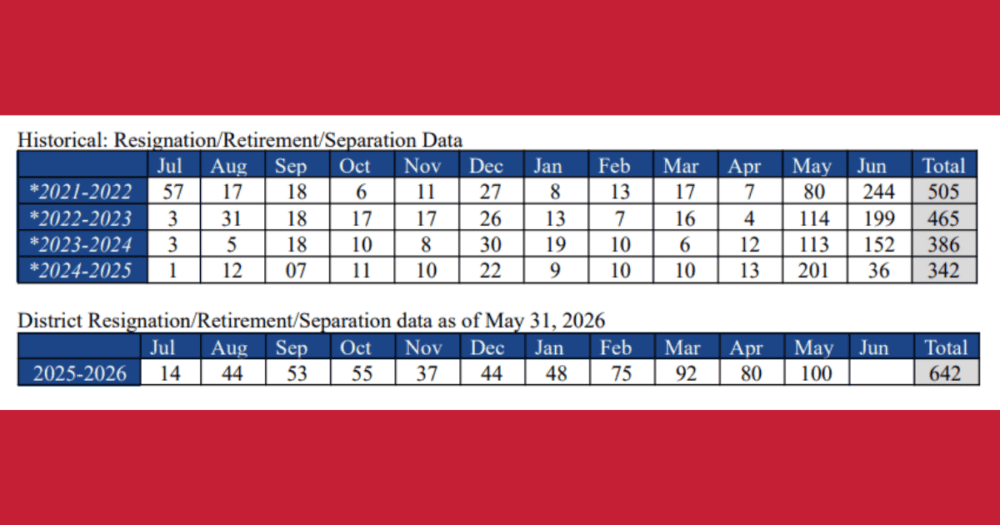
- Staffing and turnover: Trustee Matt Friez asked administrators why the district’s staffing report shows turnover running well above last year’s. The district’s June staffing report listed 642 resignations, retirements, and other separations through May, well above the full-year totals the district reported in recent years, which ranged from 342 to 505.
District officials said the higher count reflects a corrected counting method, not a surge in departures. They said the district had poorly maintained data from previous years, making historical comparisons difficult to verify.
Superintendent Stephanie Howard said overall turnover is at roughly 20-21%, in line with the statewide teacher average of about 19-20%, and that the district has retained 88% of its highest-rated teachers under the state’s teacher incentive program. As of May 31, the district reported a 95% teacher fill rate with 75 positions unfilled and a 92% bus driver fill rate with 5 openings.
Trustee Brandon Hodges noted that MISD created many temporary positions using roughly $80 million in federal COVID-19 relief funds. He said that as those funds expired, the district eliminated many of those positions.
- Holding students back: Administrators reported that they invited about 3,000 students to summer learning, pre-K through 12, and roughly half participated. Trustee Tommy Bishop questioned what happens to students the district invites but don’t attend, and whether state law requires holding back students who aren’t passing.
Howard said the district cannot force attendance, but said a proposed promotion-and-retention policy is coming to the board next month that could strengthen the district’s approach. Howard said Texas no longer automatically ties fifth- and eighth-grade promotion to STAAR performance, leaving most promotion decisions to local school districts.
- Preliminary STAAR results: Administrators presented preliminary spring STAAR results showing growth at the “Meets” grade level across all tested areas, though the district remains below state averages. On end-of-course high school exams, every subject improved. Biology rose 13 points, and Algebra I and English I each gained 6 points.
In grades 3-8, reading held steady or improved in every grade, and math posted the strongest gains. Five of six grades rose, seventh grade jumped 13 points, and the district gained 26 cumulative percentage points across the grade band. Officials said MISD improved faster than the state average in nearly every tested subject.
Fifth- and eighth-grade science comparisons will not be available until July, and final state accountability ratings are due August 14. Trustees Sara Burleson, Bishop, and Friez thanked staff, with Friez calling the gains a refreshing turnaround from what he described as a decades-long decline while noting the district remains significantly behind the state.
- Employee health insurance: Administrators said they project the district’s self-funded employee insurance plan to spend roughly $4.6 million more than budgeted this year. The district contributes $503 per employee per month.
Trustees discussed the MISD Care Clinic, a $10-copay walk-in clinic the district runs with Midland Memorial Hospital and the City of Midland. Officials said the district is pressing the hospital to expand to more locations, evening and weekend hours, primary and urgent care, and management of chronic conditions to steer employees away from costly freestanding emergency rooms.
- New school roads: The board committed about $537,627 in bond funds toward right-of-way needed to widen Wadley Drive near the new Midland High School. They also approved $428,000 for the extensions of Thomason Drive and Avalon Drive serving the new Midland Lee High School. City reimbursements reduce the district’s net cost to about $27,500.
- 2026-27 budget: Trustees adopted the district’s first balanced budget, totaling $468.5 million, in recent years after roughly $47 million in spending reductions over the past two years. The district expects to propose a flat tax rate when the board adopts a rate in September. (See our full story on the 2026-27 budget.)
- Classroom devices: Trustees approved major changes to how students use district-issued devices next year, ending take-home devices for pre-K through eighth grade and replacing them with classroom device sets, and blocking YouTube in those grades. (See our full story on the device-policy changes.)