
Terry Johnson on governing Midland County like a business
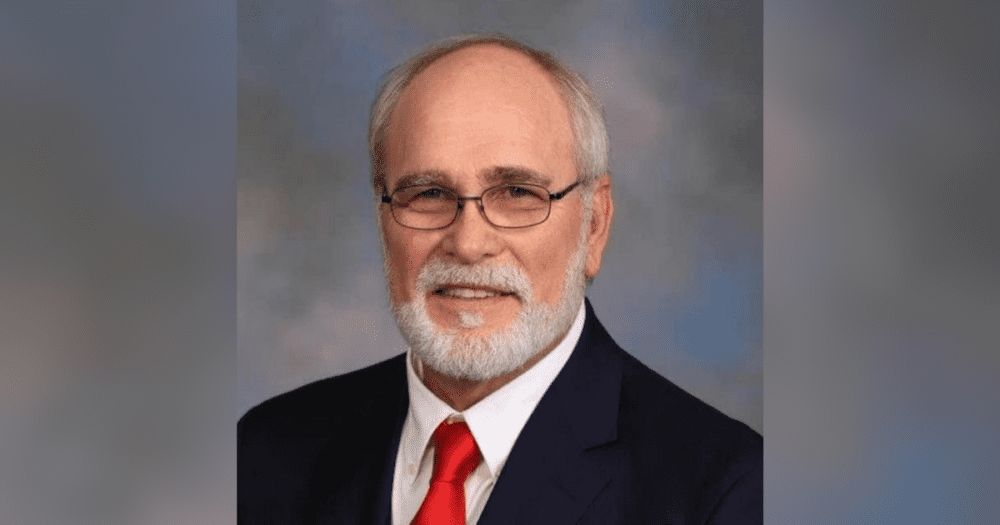
Editor’s note: Terry Johnson is running for a third term as Midland County Judge, who presides over the Commissioners Court, the county’s governing body. Johnson faces challengers Jay Marquez, with whom The Permian Press has an interview scheduled, and Karen Hood, with whom The Permian Press is in discussions to schedule an interview.
Candidate interviews are published in the order they are conducted. This article will be updated as they become available. Candidate interviews are conducted using a standard set of questions, with follow-up questions tailored to each candidate’s responses. Register to vote by Monday, Feb. 2. Early voting begins Tuesday, Feb. 17. Primary Election Day is Tuesday, March 3.
When Terry Johnson talks about Midland County, he talks about it as an operation: a $244 million budget, more than 700 employees, hundreds of vehicles, and hundreds of miles of roads to manage. In Johnson’s view, the county should be run as a large enterprise responsible for spending taxpayer dollars efficiently and deliberately.
“I look at myself as a business manager here. Nothing more, nothing less,” he said.
Roads and law enforcement “will always be the job.”
Johnson repeatedly returned to the same point during the interview: county government exists for two primary purposes.
“Those two things will always be the job,” he said, referring to roads and law enforcement. “I don’t know if I can ever say I’ve done enough or been successful, because it will constantly need improving.”
When Johnson took office, he said the county’s road system had been neglected for decades. In the 20 years prior, roughly $40 million had been spent countywide. In some precincts, he said, nothing at all. In the seven years since, he said the county has spent more than $200 million.
Running the county like a business
Rather than continuing to address roads piecemeal, Johnson said the county created a public works department and hired private-sector professionals to run it. The county inventoried every mile of road and graded them from A to F, a system that now determines project priority and spending.
“We don’t chase our tail,” he said. “We’re methodically doing the plan we laid out.”
That approach, he acknowledged, frustrates some residents.
“We have to prioritize,” he said. “It does make some people mad, and I hear them, but I have to go with what makes business sense.”
Water, growth, and who pays for infrastructure
Johnson applies the same thinking to water infrastructure in Greenwood, where residents rely on private providers, wells, or the possibility of a Midland County Utility District (MCUD) bond. He contrasted that with a utility district model, where the community serves as the investor.
“Private enterprise is in it to make a profit,” Johnson said. “If MCUD does it, they’re not in it for profit.”
Johnson was blunt about what that means for residents. He said the first MCUD bond proposal was “way too high,” but he remains convinced that a large-scale solution will require large-scale funding.
“If they want water delivered to them, they’re going to have to pay,” he said. “It’s a big project to make happen, and it’s going to take big dollars, and it’s going to take a lot of time.”
Editor’s note: Midland County and the MCUD are separate taxing entities, and any proposed bond rests entirely with MCUD. County officials may still provide analysis or context on infrastructure needs for residents and MCUD.
Sales tax as a tool for big projects
When Johnson talks about sales tax, he describes it as a tool to finance large, capital-intensive projects. Johnson said sales tax differs from property tax in that much of it is generated by oil and gas companies operating in Midland County and ultimately passed on through the price of energy sold beyond the region.
Johnson said he supported a 2021 county-wide vote to increase the sales tax, which failed. He said the county could have used the additional revenue to help fund the new jail. Initially projected at about $100 million, the project ultimately cost $170 million. The county issued a certificate of obligation, but Johnson said strong finances allowed it to borrow only $155 million.
Editor’s note: Certain government entities can issue certificates of obligation to finance major projects without a voter referendum, subject to public notice requirements.
“Our finances are so good that people paid a premium on those bonds, and we only have to pay back 155 million, but we got 170 put into our account,” he said. “I’m very proud of where we are, proud of what we’re doing.“
Johnson described maintaining the old jail as “putting band aid after band aid” and said he feared someone would eventually be killed if conditions did not change. When discussing the jail, Johnson pushed back on the idea that every major expenditure requires a public vote.
“You elected us to run your business, and five of us decided with all the information that we could gather that’s the best way to do it, and we did it above board,” Johnson said.
“All hands on deck” for law enforcement
Johnson spoke at length about the Midland County Sheriff’s Office, which he said was significantly under-resourced when he took office.
“When I started seven years ago, a patrol deputy started at $38,000,” Johnson said. “Recruitment was horrible for the sheriff’s department. They would go to the [police], and I don’t blame them.”
Since then, starting pay for county patrol deputies has risen substantially. Johnson said that as of Oct. 1, the starting salary will be $80,000. He also described restructuring pay to emphasize promotion and performance.
“There is no thumb on the sheriff’s department,” he said. “It’s all hands on deck. We’re going to do whatever we can.”
Johnson’s comments raise a question that rarely surfaces in local political debates: what level of public safety justifies what level of cost, and how does government know when additional spending produces diminishing returns? Johnson did not define a specific threshold. Instead, he described a governing posture rooted in closing gaps and expanding capacity.
Managing advantage, not abusing it
Johnson readily acknowledges that Midland County’s financial position gives it advantages other counties do not have.
“I’m the luckiest county judge in the state of Texas,” he said, pointing to the county’s high taxable property value. “That’s why our property tax rate is so low.”
Johnson said his responsibility is to manage those resources carefully and that doing so requires a business-minded approach.
“I’ve got seven years under my belt,” Johnson said. “I know this job.”