
Voters reject $450 million Midland College bond
What happened: Voters decisively rejected Midland College’s $450 million bond proposal during the May 3 Joint Special Election.
Why it matters: The bond, which aimed to fund facility expansions and campus upgrades, was opposed by 71.5% of voters. A total of 11,093 ballots were cast in the Midland College race, representing just 11.7% of registered voters. Of those, 7,931 voted against the bond, while 3,106 voted in favor.
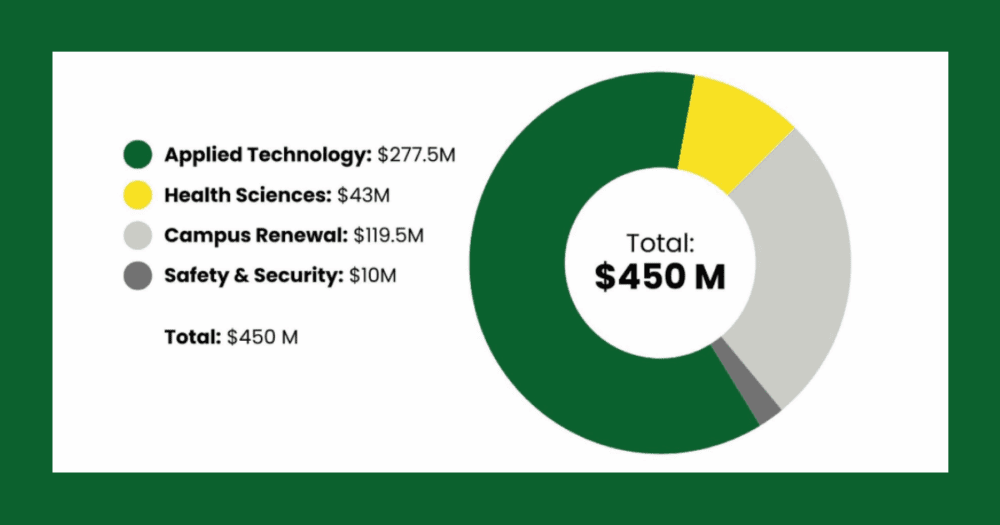
The big picture: Below is an overview of what the bond would have funded. The $450 million package focused on four key areas:
-
Career and technical education: The largest share, $277.5 million, or 62% of the total, was dedicated to building new career and technical education (CTE) facilities. This included:
- $132.9 million for more than 225,000 square feet of new construction, estimated at $590 per square foot
- $144.6 million for infrastructure, equipment, an operations center, and contingency costs
-
Health sciences: More than $43 million (10% of the bond) would have funded upgrades to the Health Sciences building. The plan called for:
- 5,400 square feet of new space for medical assisting and vocational nursing at $830 per square foot
- 30,000 square feet of renovations, also at $830 per square foot
- $13 million for infrastructure, equipment, and contingency
-
Campus renovations: The college allocated $119.5 million (26%) for renovations to existing facilities and landscaping. Midland College did not disclose the total square footage to be renovated in this category. Projects included:
- Updates to the Scharbauer Student Center, Fasken Learning Resource Center, Langford Chaparral Center, Technology Center, and Allison Fine Arts Building
- Improvements to residence halls, a utility plant, and irrigation systems
-
Safety and security upgrades: The final $10 million was set aside for campus safety improvements. These included call boxes, lighting, cameras, and signage. Midland College has its own police department, staffed by eight sworn officers and seven public safety officers. From February to April 2025, the police logged 11 reported crimes.
Reality check: If passed, the bond would have raised taxes. A homeowner with the average Midland property value of $345,961 would have seen an annual increase of $172 for 30 years, according to Midland College estimates.
What they’re saying: Midland College Works PAC, chaired by Kelsie Rasure, promoted the bond, stating that workforce-related facilities were at capacity and that the bond was essential to educating the skilled workers needed for Midland’s future. Following the bond’s failure, Midland College released a statement to the Midland Reporter-Telegram:
“The needs that prompted this proposal still exist — and will only increase as our region grows.”
The other side: Citizens for the Reduction of Debt GPAC, chaired by Stan Smith, opposed the bond. Their messaging focused on affordability and skepticism of need, with slogans such as “We don’t need it, and we can’t afford it” and “It’s OK to vote no.” The group’s simple, fiscally conservative messaging appeared to resonate with voters. On their website, midlanddoge.com, the opposing group offered the following sentiment:
“Citizens For The Reduction Of Debt, the opposing GPAC, spent $3.20 per vote while Midland Works spent $78.76 per vote,” the group stated. “We think those numbers speak for themselves.”
What’s next: While no new proposal has been announced, it is expected that the college will eventually revisit the idea of a bond in the coming years.