
MCUD report details what $299M water bond would build
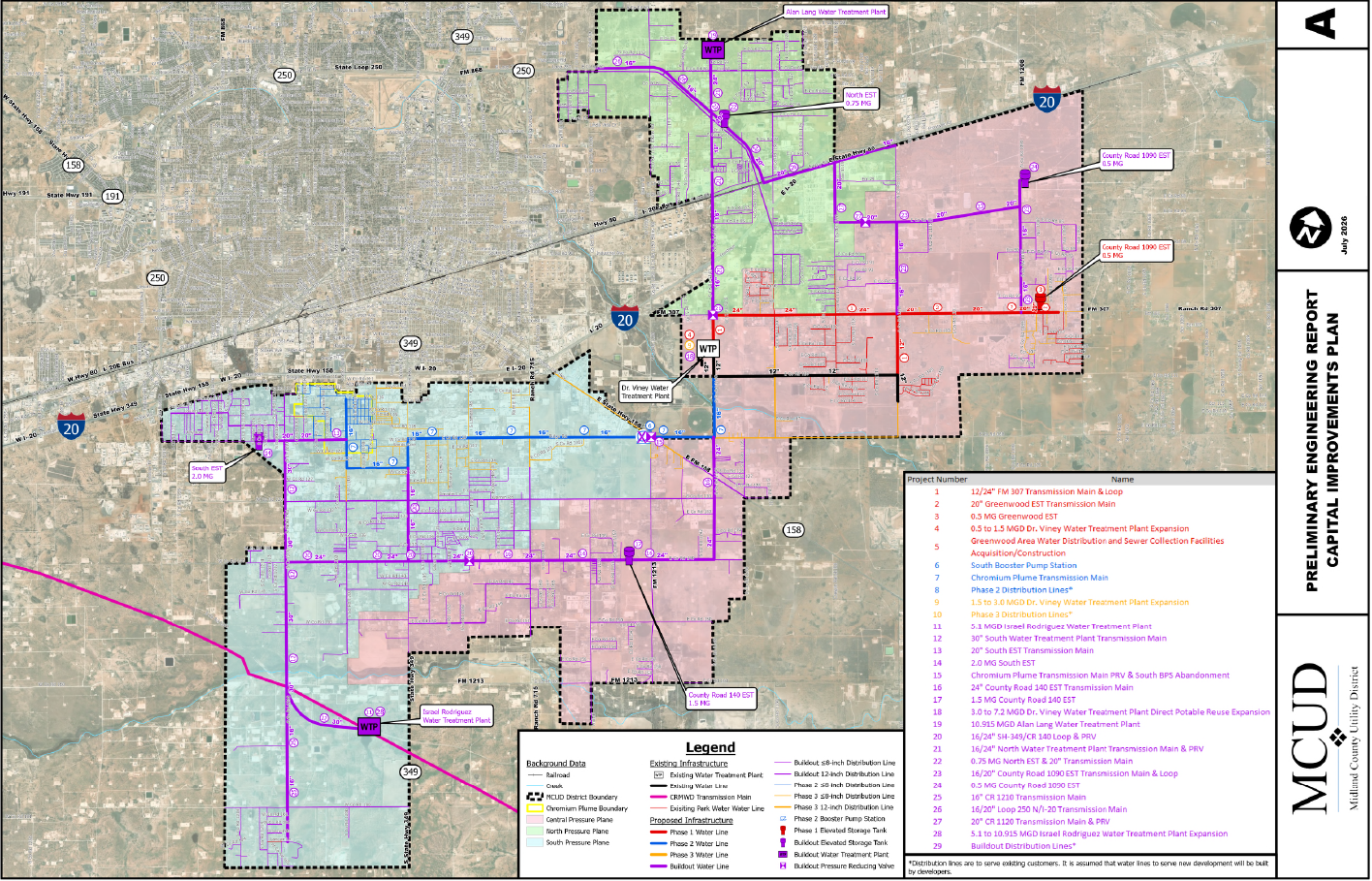
What happened: The Midland County Utility District (MCUD) released the engineering report behind its proposed $299 million November bond election. The report lays out what the bond would build in three phases: water infrastructure in the Greenwood area first, the chromium-contaminated area south of Midland second, and the areas in between third.
The plan estimated these projects to cost $279.4 million after accounting for rising construction costs. The remaining $19.7 million of the $299,015,000 bond would cover the costs associated with borrowing and issuing the debt.
Editor’s note: MCUD is not associated with Midland County government. It is a voter-created, taxpayer-supported public utility district.
Catch up quick: The $299 million bond would pay for only part of MCUD’s planned water system. The report estimates that finishing the rest would cost another $890.6 million in today’s dollars. MCUD General Manager Norman Ashton previously estimated the total cost of eventually bringing public water infrastructure throughout the district’s 85 square miles at about $1.2 billion.
The district previously said that approving the bond would increase the portion of MCUD’s property tax used to repay debt, while its existing 3-cent maintenance-and-operations tax would remain flat under its 10-year financial model. Ashton told KWEL’s The Morning Show that the estimated bond tax and monthly water bill combined would cost the average homeowner about $131 per month.
The big picture: The report divided the district into three sections for planning the future water system: North, Central, and South. If the entire system is eventually built, the report projects it could serve 46,880 water connections and need as much as 29 million gallons of water per day.
Today, the report says that MCUD serves the equivalent of about 508 connections, primarily Greenwood ISD schools and the county’s new jail.
The November bond would build infrastructure for roughly 9,200 more connections in three phases:
- Phase 1 — Greenwood area, $91.2 million: This phase would build infrastructure for about 1,675 connections in the Greenwood area where some private wells have failed, and residents haul water. It includes $14.7 million for a major water line along FM 307 and $16.2 million for another major water line and a 500,000-gallon elevated water tank.
The phase also includes $20.1 million to triple the Dr. Shelton Viney Water Treatment Plant’s capacity, from 500,000 to 1.5 million gallons per day. Another $35 million is set aside for acquiring or building water and sewer infrastructure, which could potentially include MCUD’s ongoing discussions about acquiring Park Water, PBWR, Greenwood Water, and Park Sewer.
- Phase 2 — chromium plume area, $39.8 million: This phase would build infrastructure for about 2,116 connections south of Midland where groundwater contamination has made some private wells unusable. It includes a pumping station, a $14.7 million major water line into the contaminated area, and $15 million in neighborhood distribution lines.
- Phase 3 — areas in between, $148.4 million: The largest phase would build infrastructure for about 4,902 connections between the first two areas. It includes $47.7 million to double the Viney treatment plant again, from 1.5 to 3 million gallons per day, and $66 million in distribution lines to get that water to customers.
Go deeper: For the first portions of the system, MCUD plans to rely on its existing Ogallala wells and treated wastewater. The wells can provide enough water to produce about 3 million gallons of drinking water per day after treatment. The reuse supply could produce another roughly 4.2 million gallons per day after treatment.
For later expansion, MCUD’s plan assumes it will purchase water from the Colorado River Municipal Water District and build two additional treatment plants. However, the district does not yet have a water source identified for the northern portion of MCUD. The report says expansion into that area would have to wait until a water source is developed.
Zoom out: Even after the three bond phases are completed, the report identifies 19 more projects costing an estimated $890.6 million in today’s dollars to finish the system. Those future projects include a $171.9 million expansion that would turn treated wastewater into drinking water, two new water treatment plants costing $88.5 million and $139 million, another $65.8 million plant expansion, and $263.5 million in additional water lines.
None of that is included in the November bond. Paying for those projects would require future decisions by MCUD.
Ashton previously said the district’s strategy is to use this $299 million bond to reach the areas with the greatest need and begin collecting water bills from new customers, Greenwood ISD, and the county jail. That new water revenue could then help the district borrow money for later expansions, rather than asking property owners to pay for the entire system through property taxes.
Ashton has also said the $299 million bond would help MCUD qualify for other sources of financing, including lower-interest state and federal loans and potential grants.
What’s next: MCUD voters will decide on the $299 million bond Nov. 3, with early voting Oct. 19-30. Only registered voters who live within MCUD’s boundaries will vote on the proposition. Property owners within the district pay MCUD property taxes whether or not they are connected to its water system.