
The ancient discovery that put Midland on the map
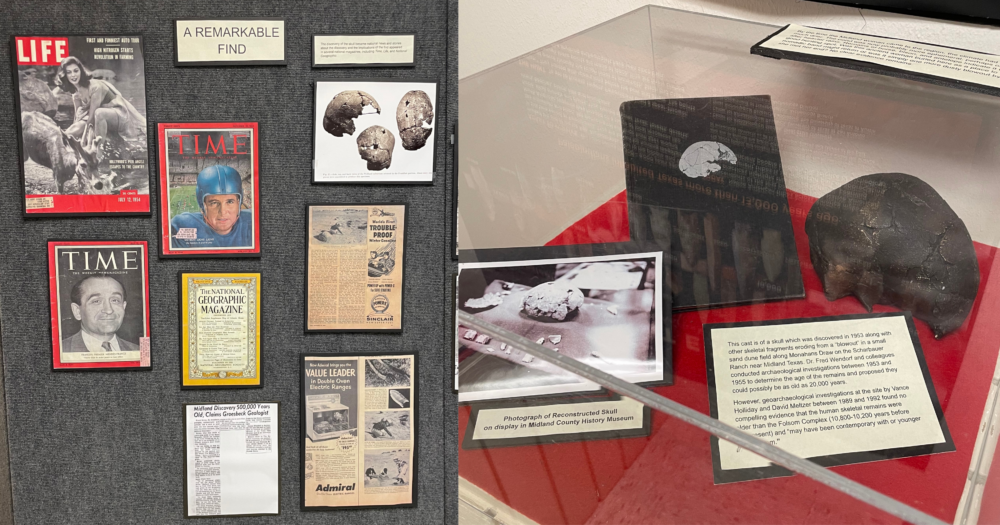
Photo: Midland County History Museum replica and famous publications
What happened: In 1953, amateur archaeologist Keith Glasscock discovered human remains in dunes just south of Midland. An excavated partial skull was initially called “The Midland Man,” but further study revealed it belonged to a young woman from the Paleo-Indian era. At the time of its discovery, the Midland skull was among the oldest human remains ever found in North America.
On Tuesday, June 9, at 11:30 a.m., the Permian Basin Petroleum Museum will host a special lecture exploring this important piece of local history. Barth Robbins, a member of the many local and Texas Archeological Societies, will present “The Midland Discovery Story” as part of the museum’s Brown Bag Lunch & Lecture Series.
The big picture: Glasscock, a pipeline welder and avocational archaeologist, discovered the bones in June 1953 while surface-collecting artifacts in a dune blowout approximately six miles from Midland on the Scharbauer Ranch near Monahans Draw. Along with the skull, he recovered two rib fragments, three finger bones, and a few teeth. Excavations followed in 1954 and 1955, led by Dr. Fred Wendorf and others.
Dating methods at the time suggested the estimated 30-year-old woman lived roughly 9,000 to 11,000 years ago during the Paleo-Indian period. At the time, little was known about early human presence on the Llano Estacado. The Midland discovery provided one of the first direct associations between human bones and a specific tool type in the region.
The discovery received national media attention, eventually leading to the placement of historic markers near the original discovery site. The original skull was eventually placed in the care of the Smithsonian Institution’s National Museum of Natural History, where it remains today.
Go deeper: The discovery of the Midland Man led to the identification of a distinct projectile point type, later named the Midland Point. This discovery showed that people were not only present but actively hunting and living in the region thousands of years ago.
Replicas of the skull are on public display at both the Sibley Nature Center (as part of its paleo exhibit) and in a dedicated section of the Midland History Museum.
The bottom line: The Petroleum Museum event is free and open to the public, with drinks and dessert provided. For more information, visit petroleummuseum.org.