
Downtown TIRZ weighs $464K in property improvement grants
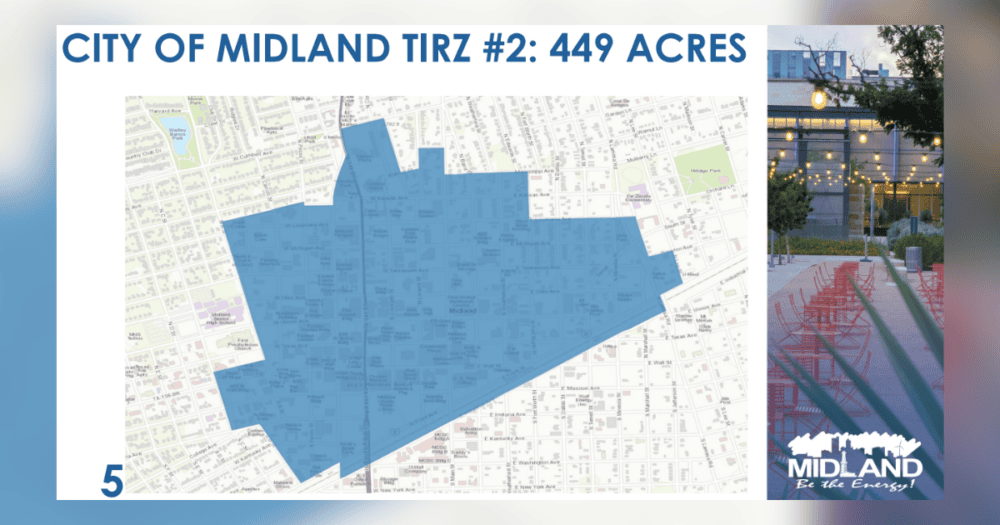
What to watch: Midland’s Tax Increment Reinvestment Zone (TIRZ) No. 2 board will meet Tuesday, Sept. 29, to review the Downtown district’s first year of property-tax revenue growth and consider using $464,000 for matching grants to improve building façades, sidewalks and outdoor dining areas.
The board will also elect a chairman and vice chairman and hear its 2026 annual report, which shows taxable property values within the zone have grown about $89 million above the value established when the TIRZ was created.
Catch up quick: TIRZ No. 2 covers roughly 449 acres of Downtown Midland. The city created it on Nov. 14, 2023, and the zone is set to run through Dec. 31, 2053. City Council approved a $124.1 million plan for the zone in December 2025 to fund projects such as parking, utilities, street and pedestrian improvements, and encourage private development such as hotels, apartments, and retail.
When the TIRZ was created, the taxable value of property inside its boundaries was set as a starting point, or “base value.” As downtown property values rise above that amount, the additional property tax revenue generated by that growth is set aside for projects within the TIRZ rather than going into the participating taxing entities’ regular budgets.
Why it matters: The City of Midland, Midland County, Midland College, and Midland Memorial Hospital District have agreed to put 100% of the additional property tax revenue generated by growth above that starting value back into the downtown zone.
That money can fund improvements intended to encourage more downtown development, which could in turn create additional property and sales tax revenue. However, it also commits future property tax growth to downtown projects for decades instead of allowing the participating taxing entities to spend it elsewhere. Midland City Council must still approve how the TIRZ board recommends spending the money.
The big picture: The taxable value within the zone increased from its roughly $527.8 million starting value to about $617.2 million, an increase of $89.3 million, or 16.9% during fiscal year 2026. That growth generated about $489,500 for the TIRZ. The zone generated no revenue the previous year because property values had fallen below the starting value. For fiscal year 2027, the report projects the TIRZ will generate about $554,200.
The annual report points to development underway or recently opened within the zone, including the Omni Midland, Tapestry and Residence Inn hotels and restaurants The OSO Room, Marfa Cowboy, Saint Blaise and Georgie’s Place.
Go deeper: City staff is proposing that TIRZ No. 2 use most of its first year of available revenue for three grant programs aimed at improving private properties and sidewalks Downtown. The proposal would allocate $464,000 of the zone’s $489,543 fund total, leaving about $25,500 uncommitted.
Because each grant would require property owners or businesses to provide an equal match, the city estimates the $464,000 in TIRZ money could produce $928,000 in total investment.
- $270K for building façades: Property owners could receive up to $25,000 per parcel to improve building exteriors, and owners must match the grant dollar for dollar. Staff estimates the money could fund 10 to 13 projects in the first year.
- $120K for sidewalks: Property owners could receive up to $15,000 per parcel to repair deteriorated sidewalks, uneven pavement, and other pedestrian barriers. The grants would also require a 50/50 match, and staff estimates it could fund eight to 10 projects.
- $74K for sidewalk cafés: Downtown businesses could receive up to $7,500 each for outdoor dining improvements such as seating, shade, barriers, and planters. Businesses would provide an equal match, and TIRZ funding is estimated to support about nine projects.
These programs are not final yet. If the board agrees with the concept Tuesday, staff would develop detailed rules and bring them back to the board for consideration at a future meeting. All three programs are proposed as reimbursement grants, meaning recipients would be reimbursed for eligible improvements rather than receive the money upfront.