
Midland makes its case for higher spending as budget season begins
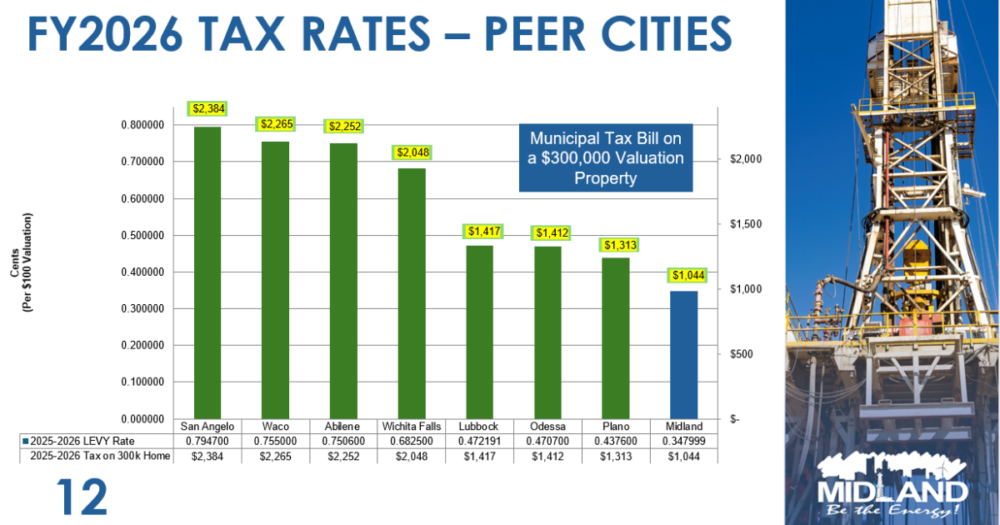
What happened: The city recently released two staff presentations outlining what Midland spends and plans to spend across its various departments. The presentations come as the city prepares its 2026-27 budget and accompanying property tax rate.
During the July 21 council meeting, City Manager Tommy Gonzalez said the city’s goal during the upcoming budget process is to get “as close to no-new-revenue as we can.” Council will hold a budget workshop on Wednesday, Aug. 12, to set the maximum property tax rate before budget and tax rate hearings on Tuesday, Sept. 8 and Tuesday, Sept. 15.
Why it matters: The presentations note that Midland has the lowest property tax rate and tax bill among eight peer cities and lowered its property tax rate four years in a row. Even so, property tax collections grew 71%, from about $44 million in 2016 to more than $75 million in 2025, as Midland’s taxable property base nearly doubled because of rising values and new development.
When the city adopted its current $461 million budget last fall, the latest rate cut still resulted in about an $8 increase for the average homeowner.
The big picture: The city’s presentation on the cost of its offerings argues that Midland’s rapid growth has expanded both the city’s responsibilities and its operating costs.
According to the presentation, Midland added roughly 14,000 residents over the past five years, along with 112 miles of water infrastructure, 132 miles of roads, and 3,565 new single-family home permits. At the same time, the city says it now has about $335 million in annual fixed costs from personnel, contractual obligations, commodities, maintenance, and utilities.
The presentation also shows that EMS calls increased 62% over the past nine years, while fire-related calls rose 55%. It estimates Midland will spend $104.1 million on emergency response in 2027. Emergency response is Midland’s single largest non-enterprise fund budget item, and Midlanders are paying more for emergency response every year.
As The Permian Press previously reported, however, those increases were not driven solely by population growth. The city and its council deliberately chose to increase emergency response spending faster than the property tax base grew.
Go deeper: The second presentation focuses on parks maintenance and capital investments.
According to the presentation, the city now has more than $150 million in parks projects that are complete, under construction, or in design. Those include the Beal Soccer Complex, the Diamondback athletic facility, renovations at The Courses at Hogan, the RMN baseball complex, Scharbauer Sports Complex auxiliary fields, Wildcatter Trail, the Doug Russell Aquatic Center, and new neighborhood playgrounds.
The city credits public-private partnerships with contributing more than $55 million toward those projects.
As those facilities come online, the city’s long-term maintenance obligations continue to grow. The parks division now maintains 189 athletic fields, up from 135 in 2020, and 28 synthetic turf fields, up from 12. Annual fixed operating costs are now about $10.8 million, and the city’s five-year capital replacement forecast identifies $16.6 million in future parks and pools replacement needs.
Reality check: Both presentations explain why some city spending increased over time and why staff believes it has additional spending needs, largely due to Midland’s growth and rising costs. However, taxpayers should question whether each new program, facility, or offering provides enough public benefit to justify its ongoing cost.
Midland is a growing city, and population growth and inflation naturally increase the cost of city government. However, Texans for Fiscal Responsibility shows how local spending has far exceeded population growth plus inflation since 1996.
As the state prepares for the 90th Legislature to begin in 2027, Gov. Abbott released his proposal for lawmakers to consider installing safeguards to limit local spending growth to the lesser of population plus inflation or 3.5 percent.