
Park Water seeks to expand in Greenwood, MCUD objects
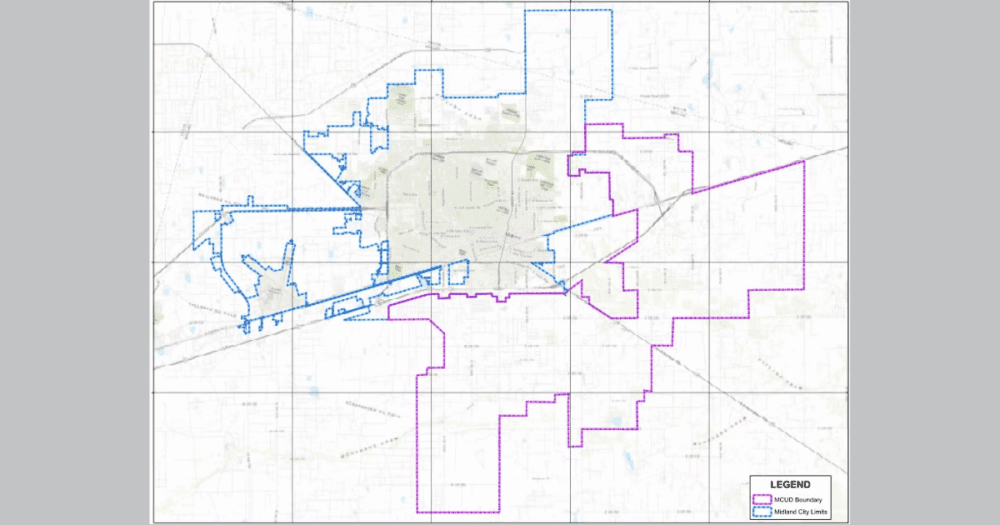
What happened: Park Water Company has filed two applications with the Public Utility Commission of Texas (PUC) asking to expand its Certificates of Convenience and Necessity (CCNs) in and around Greenwood. A CCN gives a provider the exclusive right to supply water within a defined service area.
In response, the Midland County Utility District (MCUD) filed motions to intervene, arguing that the expansions could conflict with the public system MCUD was created to build. Sen. Kevin Sparks requested clarification from the PUC about the scope and legality of the filings. Editor’s note: MCUD is not associated with Midland County government. It is a voter-created, taxpayer-supported public utility district.
Why it matters: In 2013, voters in the MCUD boundary approved forming a public water district, but MCUD has no operational infrastructure today. Its revenue alone is not large enough to build a system without major financing. The district proposed a $645 million infrastructure bond earlier this year, which voters rejected.
Over the past four years, MCUD collected under $14 million in property taxes and other revenue and spent less than $2 million, mostly on engineering and water rights.
Park Water seeks to expand its private service territory, yet its filings do not explain why they want the expansion, how many more customers it intends to serve, or whether its water system can support the new area. MCUD argues that granting those expansions without those details could interfere with the district’s long-term plan to build a unified public system.
The big picture: Greenwood is unincorporated, meaning neither Midland County nor the City of Midland can provide water service. Only private utilities, individual wells, or a special district like MCUD can serve the area. Greenwood residents face inconsistent water pressure, reliance on private wells, and long-term concerns about aquifer depletion.
Go deeper: Park Water submitted two formal applications (PUC Dockets #58751 and #58754) asking to:
- Ask #1: expand its service area by enlarging its CCN boundaries in a region overlapping MCUD’s territory.
- Ask #2: add additional acreage outside the current boundary, extending its reach into unserved areas.
The filings do not include demand projections, engineering details, or capacity information, documentation typically provided in CCN expansions. Without it, residents have no clear picture of what Park Water intends to build or whether it can supply the expanded territory.
Key points: MCUD’s motions to intervene raise concerns in three major areas:
- Statutory authority: MCUD argues that Texas law already grants the district the responsibility for planning public water service within its boundaries, and that Park Water’s proposed expansions could undermine that statutory role.
- Infrastructure conflicts: MCUD contends that it is planning long-term, districtwide infrastructure, an undertaking that requires unified service areas. Private expansions inside MCUD’s boundaries could lead to a patchwork system that is more expensive to build around.
- Public investment and transparency: Because taxpayers fund MCUD, it must justify its long-term spending and planning. Private companies, like Park Water do not have to explain their plans publicly. MCUD argues that the PUC should not approve CCN changes without complete clarity about how the expansions would impact the district’s ability to build a reliable public system.
MCUD has asked for full public hearings so the Commission can examine these issues openly before approving any boundary change.
What’s next: The PUC will review all filings, decide whether to open a contested case, and determine if it will allow public hearings. MCUD has said it plans to present another bond election for November 2026.