
Why Texas decided your kid should know America’s founding

Editor’s note: This is Part 1 of a four-part series on the new civics instruction coming to Texas elementary schools this fall and the training Texas teachers and administrators are completing this summer to deliver it. Part 1 is an overview. Part 2 examines the law and the lawmakers behind it. Part 3 goes inside the teacher training. Part 4 looks at what students will actually learn.
What to watch: When Midland’s elementary students walk back into class this August, class time might feel a little more red, white, and blue than before.
Imagine students in math class working out what the United States paid per square mile for the Louisiana Purchase. Or, in language arts, analyzing the roots and meanings of the words in the Pledge of Allegiance. Maybe your kindergartener plays a game that tangles the class in knots until they cooperate to break free, after which they collectively write and sign their own classroom “declaration.”
We are about to witness the biggest change to how Texas teaches civics in a generation. Elementary teachers and administrators are already receiving training to deliver civics instruction built around the founding documents of the United States and Texas, and it is arriving, fittingly, in the year the country turns 250.
Why it matters: There is a measurable reason our state’s children need this. On the most recent National Assessment of Educational Progress civics assessment in 2022, eighth-graders’ scores fell for the first time since the test began in 1998, and only 22% reached the “proficient” mark. That assessment draws a sample of roughly 7,800 students nationwide.
Closer to home, just 17% of Midland ISD eighth-graders met grade level on the 2025 social studies STAAR, which covers the Constitution, the Bill of Rights, and the founding documents. Similarly, 28% of high school students met grade level on the U.S. History End-of-Course assessment, which covers the role and structure of government, as well as citizens’ rights and responsibilities.
But, as Dr. Dewitt Smith, Executive Director and CEO of the Region 18 Education Service Center, told The Permian Press, the previous civic state standards were “pretty vague.” What the new program does, he said, is create a structured method around a common set of documents, and it starts in the earliest grades.
-
- Civics Training Program for Teachers and Administrators
-
- Civics Training Program for Teachers and Administrators
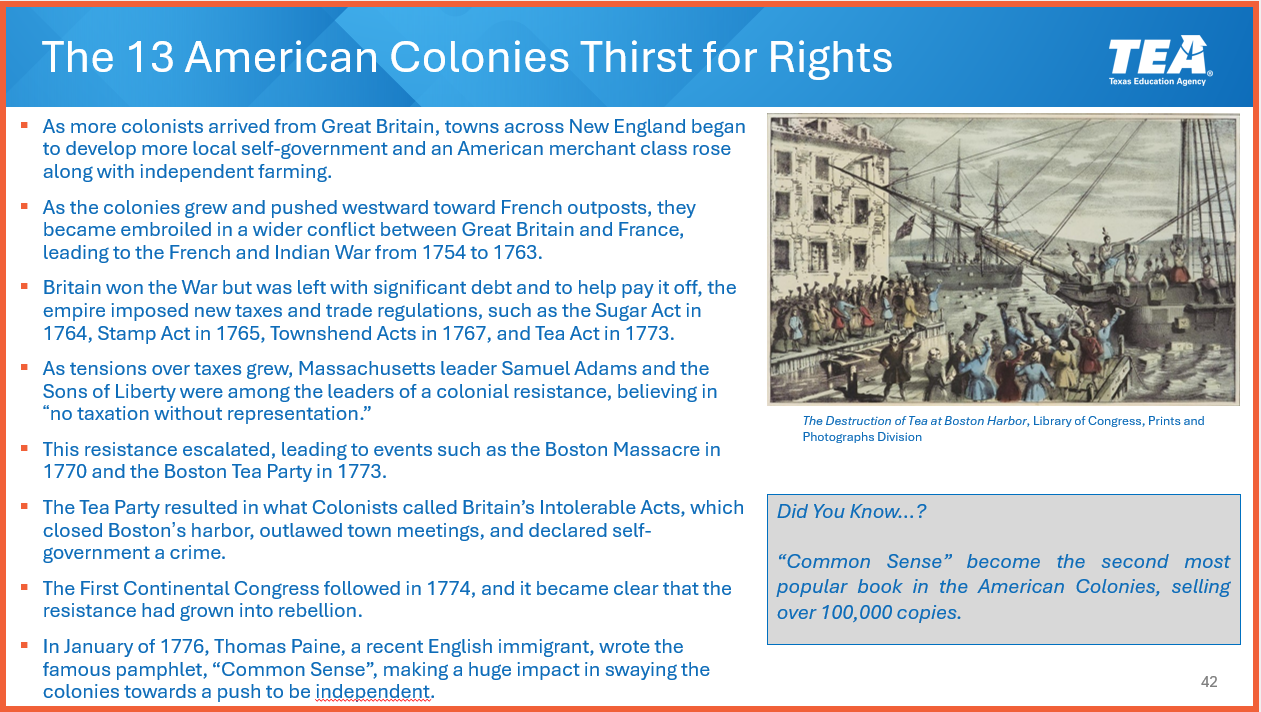
The big picture: The program traces back to a 2021 state law, Senate Bill 3, that directed the Texas Education Agency to develop a civics training program so that every K-12 campus would have teachers and administrators trained to teach civics in accordance with its directives. The State Board of Education (SBOE) approved the K-5 elementary content this February, with training covering the full K-12 span next year, pending SBOE approval of the materials.
SB 3 requires that every campus in a public school ISD or charter system send at least one teacher and one principal or campus instructional leader to the training. MISD confirmed to The Permian Press that it will send the principal and at least one teacher from each campus. The training expects teachers and administrators to take what they learn back to their campuses and integrate civics into every subject so it runs throughout the school day.
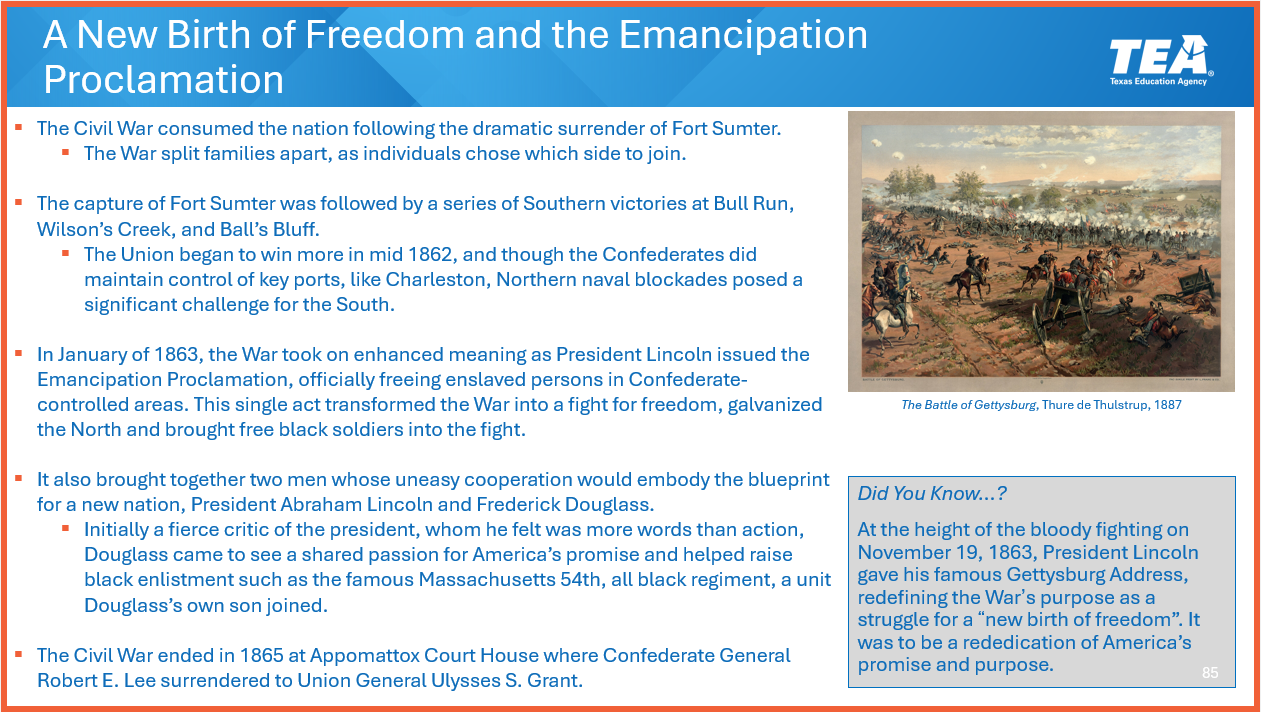
Smith, who led the team that built and delivered the training statewide, said they centered the program on a close, guided study of the founding documents themselves, read in the students’ own hands rather than summarized in a textbook, and taught in chronological order to help students more easily connect the pieces. Smith described his team’s approach to tackling SB 3’s directives as looking at a “blank canvas.”
“You’re looking at the spirit of the bill, you’re looking at what the bill is on face, and you’re trying to imagine what that then should look like once it’s painted out, and how do you get there,” Smith said.
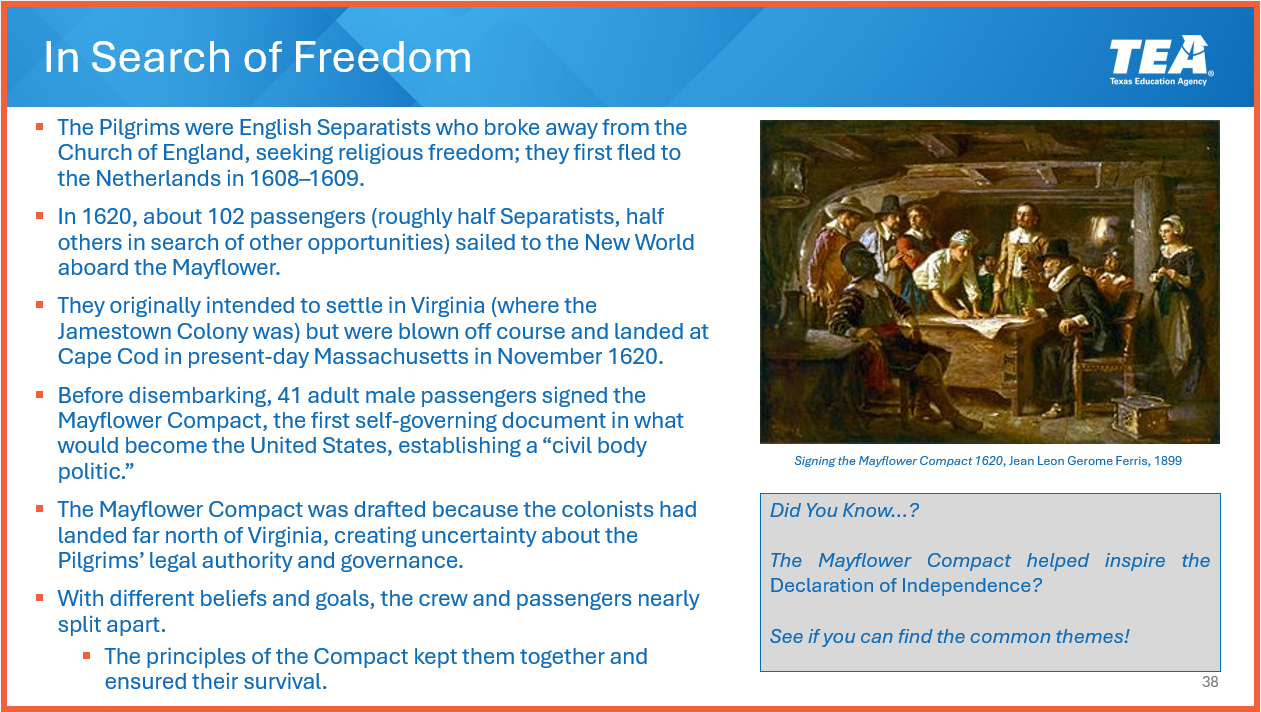
Go deeper: Smith said they anchored the elementary training around teaching four core documents: the Mayflower Compact, the Declaration of Independence, the Bill of Rights, and the U.S. Constitution, to cultivate “informed American patriotism,” pride in our country rooted in actually understanding it. The training also instructs teachers to discuss “concepts objectively, chronologically, and free from political bias,” Smith said.
“Once you do that, then you have a knowledge about the deepest and noblest purposes of the U.S. because these documents tell you that,” Smith said. “Once you get in there, you really realize how virtuous [they were], and the heroism of the day, and what they put on the line.”
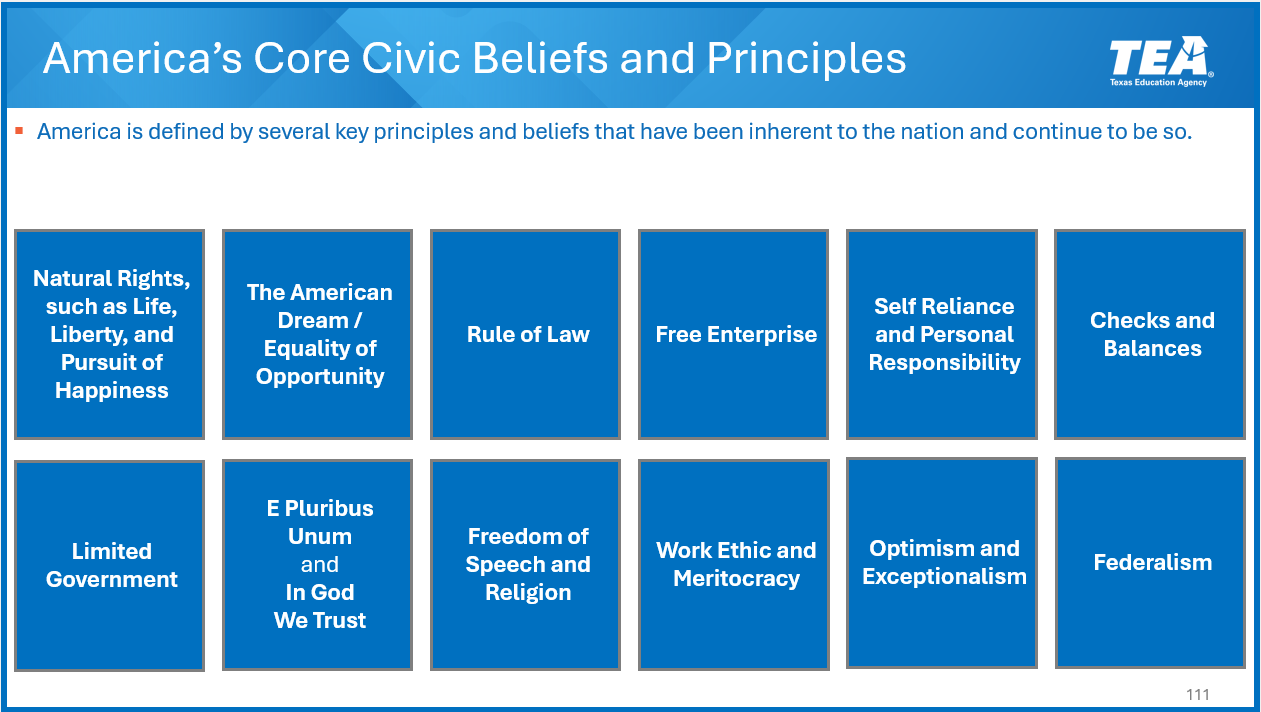
Smith said they organized the instruction around 12 defined civic ideas that the program calls building blocks. Among them are natural rights, the rule of law, free enterprise, federalism, limited government, checks and balances, freedom of speech and religion, national mottos, work ethic, meritocracy, and American exceptionalism.
For Smith, the goal is ultimately equipping students to be “productive leaders who are virtuous and service-oriented.” The documents, he said, leave a student “proud, and you understand that America is exceptional, and it is different than any nation that’s been here prior to us.”
-
- Civics Training Program for Teachers and Administrators
-
- Civics Training Program for Teachers and Administrators
Zoom out: Most states now require a civics course or test to graduate. More than 20 have passed civics policies in the last few years, with many of them leaning into the founding documents and national pride. Texas’s version is among the most fully built, including an immersive, statewide teacher-training program rather than a set of standards on paper. Still, it joins a broad national turn back toward teaching the country’s origins.
What they’re saying: “I am excited about the new civics resources that will empower Texans from a young age to understand and appreciate the foundations of our democracy,” Midland’s State Sen. Kevin Sparks said. “By teaching the self-evident truths endowed by our Creator which are enshrined in the United States Constitution, students across the nation will develop the ability to think critically and engage in civil discourse.”
“I am especially proud of Midlands role in developing this new material,” Sparks said. “These lessons will reflect the values of faith and freedom that define our West Texas communities while building a strong foundation of civic knowledge that prepares students to succeed in and out of the classroom.”
What’s next: The first wave of training is already underway. The 20 regional education service centers across Texas are training elementary teachers and administrators this summer, for two days at a time, so the instruction reaches elementary classrooms this fall.
Read part 2 of the series — How Midland built the school civics program rolling out this fall. Part 2 traces the law and the lawmakers behind it and how an Austin bill became a Midland-built civics program.