
Council continues debating ETJ projects it doesn’t control
What happened: The Midland City Council met last week on Tuesday, April 14, and approved a multi-year contract expected to generate more than $500,000 in savings, declined to act on two large industrial plats in the ETJ that will move forward regardless, accelerated enforcement timelines on long-vacant properties, and deferred a major residential rezoning request after an extended debate over how the city should manage growth.
Key points:
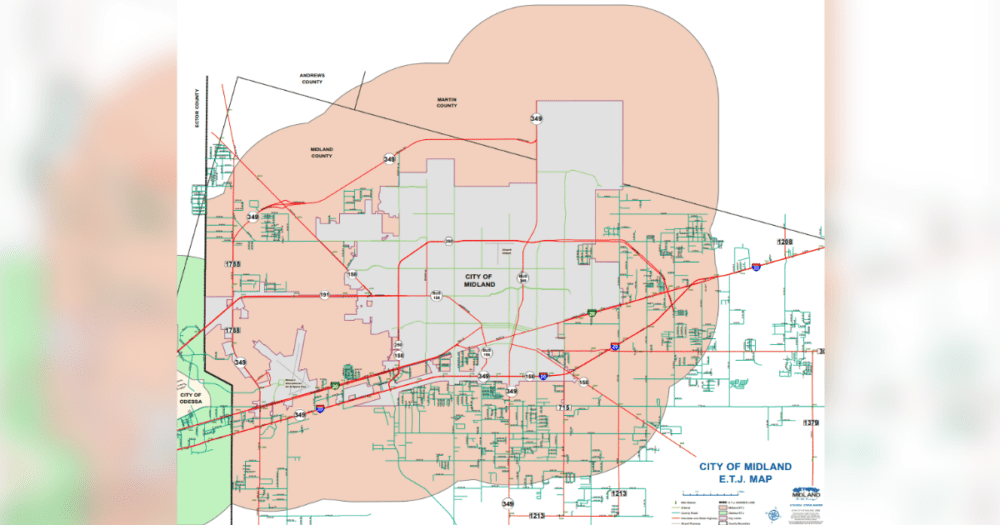
- ETJ plats: Council took no action on two large industrial plat requests within the city’s extraterritorial jurisdiction (ETJ). The ETJ is land outside city limits where the city regulates subdivision layout but does not provide services or enforce zoning. Both projects met state platting requirements, including groundwater availability studies, and will move forward regardless of council action under Texas law.
Councilman Jack Ladd questioned whether large-scale industrial uses are appropriate in high-visibility areas, particularly near the city’s arts district and future Interstate 27 corridor. Councilman John Burkholder raised concerns about water usage, noting industrial development could strain groundwater resources.
If council wants to control land use in these areas, it must work with property owners to annex them. If not, the city can eliminate the ETJ and allow development to proceed without its involvement. State law does not require cities to maintain ETJ authority, and property owners can also petition to remove their land from the ETJ. Continuing to debate projects in areas outside city control does not change the outcome.
- Substandard properties: Council approved enforcement actions for two long-vacant and deteriorating properties, both of which have generated repeated code enforcement and police calls. The city’s standard process allows owners to demolish the structure themselves, pay the city about $10,000 per property to do it, or allow the city to demolish it and recover costs through a lien on the sale proceeds.
City staff noted extensive efforts, often exceeding three to four months, to contact property owners before bringing cases to council. In both cases, council reduced the compliance timeline from 90 days to 30 days, requiring the owner to secure the property immediately and demolish or repair it within 30 days. Staff said the city has addressed about 20 such properties so far, with more than 100 remaining.
- Turf and landscaping: Council approved a three-year, $2.37 million contract for turf and landscape maintenance across certain city-owned parks and fields. The contract resulted from a competitive bidding process that evaluated vendors based on qualifications, references, and cost. The selected vendor scored highest across all categories, and the city expects it to save around $190,900 a year.
City Manager Tommy Gonzalez said broader procurement reforms and IT audits have now generated nearly $5 million in total savings.
-
Rezoning request: Council also debated a rezoning request tied to a 150-acre residential development along North Garfield that would allow more than 350 homes and limited retail. The request centers on allowing smaller lot sizes to improve affordability. The developer argued that flexibility is critical as construction costs rise. The discussion ultimately revealed a broader divide over how the city should manage growth.
Some council members supported allowing development to move forward while addressing infrastructure in parallel, while others argued the city should resolve roads, drainage, and right-of-way first. Council deferred the item to allow further coordination on infrastructure planning before returning to council in June. Read The Permian Press’ full coverage of this item.